
This article is a mobile-friendly adaptation of the piece I wrote for my sister site, Hooked-on: "Levi's 501XX 1954." If the subject interests you, I encourage you to visit the original on Hooked-on as well.
Images on this site are formatted for mobile in a vertical layout, which can appear oversized on a desktop screen. If that bothers you, the Hooked-on version may be easier to read.
[ https://en.hooked-on01.com ]
This site, inter-est, rebuilds content from my WordPress site Hooked-on using Drupal — and uses Drupal's features to enable cross-referencing between articles and browsing by related content. My hope is that visitors find their curiosity — their interest — expanding as they move through the site.
I love jeans — always a straight cut, always the orthodox silhouette. I wear many different pairs, but Levi's 501 is what I keep coming back to. The 501 has a history as long and layered as guitars or mechanical watches: a vintage secondary market exists for examples stretching from the 19th century to the present — pre-war, wartime, post-war, 50s, 60s, 70s, 80s, 90s, 2000s and beyond.
Collectors, enthusiasts, and fashion buyers alike have formed their own market around it. The rarest, best-condition examples command extraordinary prices, and the whole phenomenon has long since transcended the categories of "jeans" or even "fashion."
The 501 has influenced countless jeans: its form and details absorbed, replicated faithfully, or revisited by Levi's itself through archival reissues. The descendants of that influence are still being made today.
This article introduces the 501XX — the model I love most.
About 501XX.
The 501XX designation generally refers to models sold from 1947 through the mid-1960s.
The reason: on the rear of the jeans, to the right of the belt loop above the right back pocket, there is a product-name patch bearing both the Levi's name and "501XX." From the mid-1960s onward, the "XX" was dropped and the patch simply reads "501." Models from that point are commonly known as Big E or the 66 model.
In practice, the leather patch on vintage pairs has almost always come off or been lost. Even when it survives, the text is usually illegible. The vintage 501s on the market are therefore dated by their other distinguishing features — silhouette and construction details — rather than by the patch itself.
Models made before 1947 also carry the 501XX marking on their patches, but those earlier pairs have their own names: the WWII-era pieces are known as the "war model," and pre-war and older examples go by other designations. For this article, "501XX" refers specifically to the models sold from 1947 through the 1960s — those whose patches bear the 501XX marking.
501XX — Periods and Types
- Up to 1946 (commonly known as the war model — note: pieces from the transitional post-war period may show construction features shared between the war model and the later 47 model)
- 1947 to approximately 1953 — leather patch (early period), single-sided tab. 501XX
- Approximately 1953 to 1955 — leather patch (late period), double-sided tab, centre belt loop. 501XX
- 1955 to the mid-1960s — paper patch (classified by construction features, including with or without crotch gusset). 501XX
- Mid-1960s to mid-1970s — the models known as Big E or the 66 model
The 501XX I own and wear — the one introduced here — is the 54 Model, produced from approximately 1953 to 1955. I also own the 55 Model, produced a little later; that pair is covered in a separate article.
The Influence of the 501XX
The 501XX was mass-produced from the post-war years through the 1960s, and represents one of the finished forms of denim trousers with deep roots in workwear — a garment refined through continuous improvement over many decades.
The functional beauty of the 501XX — a workwear piece brought to its fullest form through constant refinement — was inherited by the 501 that followed and by the countless jeans the 501 has since influenced. It became the origin point of the modern jean, and that status as the original is, to me, the 501XX's greatest appeal.
Pairs made sixty years ago still exist that you can wear as everyday jeans — and the patina that comes with sixty years of aging is immediately appealing and legible. That is also part of the 501XX's appeal.
Historical Appeal
- It is the original — the origin point of the modern jean
- Sixty-odd years old as a vintage garment, yet still entirely wearable
- The character that sixty-odd years of aging have given each individual pair
- Every pair's wear pattern and condition is unique — there is only one like it in the world
- That condition cannot be reproduced
- The patina is not manufactured
- It is the genuine article that influenced the many jeans that followed
- The appeal of the aged character is immediate and readable
Earlier models than the 501XX are equally compelling — but surviving examples are rarer, the historical premium places them at very high prices, many are too fragile for everyday wear, and the silhouette differs subtly from the later 501 (which is itself part of their appeal). The jeans sold today — Levi's 501 itself, and the many jeans made in its spirit — are mostly built on the 501XX silhouette, which is why I take the 501XX to be the original 501.
(There are other valid ways of looking at this, but in terms of influence on what followed, I think the case is a strong one.)
Fashion Appeal
The 501 — including current production — is a compelling jean by any measure, and compelling even beyond jeans: a trouser that works across a genuinely wide range of contexts.
The reason I wear jeans in nearly every situation comes down to colour. If asked for the foundational colours of men's fashion, I would say blue first and grey second — and the indigo of jeans is precisely that primary blue. A colour that goes with everything is a wardrobe foundation, and indigo delivers exactly that.
The 501 is a straight jean — minimal taper — and that slightly relaxed fit means the fabric falls into creases rather than clinging to the leg. Combined with the tonal shifts of faded indigo, those creases catch the light in a way that flatters the leg and hip, making the whole look read as well proportioned.
Within that, here is what I find particularly compelling about the 501XX specifically.
As a Contemporary Fashion Item
- From the 1960s onward, the 501 silhouette became more tapered. The 501XX is a straight cut — thigh measurement slightly fuller — and it's precisely that volume that creates the creases when worn. Those creases flatter the leg.
- The 501XX carries yellow stitching — compared to the orange stitch of later models, the contrast with indigo blue reads brighter and more prominent. (On heavily faded pairs that have shifted to a pale blue, the effect reverses and the stitch becomes less noticeable.) This stitching is more appealing, to my eye, than on later models.
- The 501XX has tended to attract careful owners over the years, partly because of its recognised value — which means a relatively good proportion of surviving pairs retain strong colour, and the deep indigo remains something you can genuinely enjoy.
- Fading is the great appeal of jeans, and pairs made sixty years ago show a quality of fade that cannot be replicated — the hardware (buttons, rivets) has taken on a patina over that same time that is its own thing entirely.
- Fabric that is sixty years old has naturally softened and developed wear — holes, tears, tataki repairs — and that naturally acquired character is something entirely different from the distressing that appears in jeans produced today to simulate it.
- The denim itself is genuinely soft after sixty years, which makes these jeans very comfortable to wear. The downside is that the fabric and the stitching thread have aged, so holes and fraying come more easily.
The reasons I chose the 54 Model I own: a just-right fit (waist 30 in., length 32 in.), no damage, hem unaltered, indigo retained with depth — a pair in exceptionally good condition.
Why I Keep Wearing the 501XX
Manufactured sixty years ago, the origin point of what came after, aged into a beautiful character over that time, and the right size for me — the 501XX 1954 Model introduced here is a pleasure to wear, works with almost anything, and gets regular use. It matters to me, and I take care of it.
Wearing jeans is the foundation of my personal style. Within that, a vintage 501XX — with its history, its story, its genuine patina — is the kind of thing that keeps fashion interesting. I intend to keep wearing it for a long time.
If the 501XX Interests You
As with anything vintage, prices vary considerably by silhouette, period, and condition — an unavoidable feature of the market. Some background knowledge of the period features helps, but a good shop will price things correctly and will be happy to explain any piece that interests you. For a buyer who isn't a committed collector, a general sense of what to look for is enough — and a web search will surface detailed information. I recommend doing some light research before going.
This is a hobby category, and knowing something about the different silhouettes, details, and periods makes conversation with a knowledgeable seller more rewarding. Each pair carries its own history and aging story — and that individual character is the conversation starter that makes vintage jeans, and vintage in general, such an interesting area to be in.
Styling.
As the original of the modern jean, the 501XX accommodates almost anything. The orthodox American combination — military pieces like the M65, leather pieces like the A2 — is a natural fit, but European mode brands work equally well, and Classico Italiano tailored jackets are excellent partners.
One caveat: choosing a size larger than your actual fit works fine with American-style clothing, but mode brands and tailored jacket combinations become considerably more difficult to pull off. A just-right fit is the more versatile choice.
Brunello Cucinelli
I wear the vintage 501XX with Brunello Cucinelli, one of the defining luxury brands of today. Different cultural origins place the two in entirely different categories, but in practice they are excellent together — pairing Brunello Cucinelli with vintage jeans is one of my personal signatures.
A mouton biker jacket sits somewhere between structured and easy — not as hard as a calf leather rider's jacket, and more accessible for someone who has moved past their younger years. Brunello Cucinelli's materials and construction are simply at a different level: warm through the depths of winter, exceptional comfort, no need to layer heavily underneath — and the styling stays clean.

The cut is surprisingly compact for a jacket this comfortable — well-made pieces often surprise that way. Against the slightly fuller straight leg of the 501XX, the proportion holds; nothing reads as heavy or awkward.

The straight leg runs clean to the hem — good for proportion, and good for making a well-cut jacket read to its full effect.
A2 Deck Jacket
Paired here with the A2 deck jacket — the military-style American casual staple for winter. Lined with boa, it tends to add bulk, but the clean silhouette of the 501XX keeps the overall look together. The M65 works equally well; military pieces in general are natural partners.

Less tapered than most modern jeans, the leg opens up from the knee into a clean line. That reading lengthens the leg and improves the overall proportions.
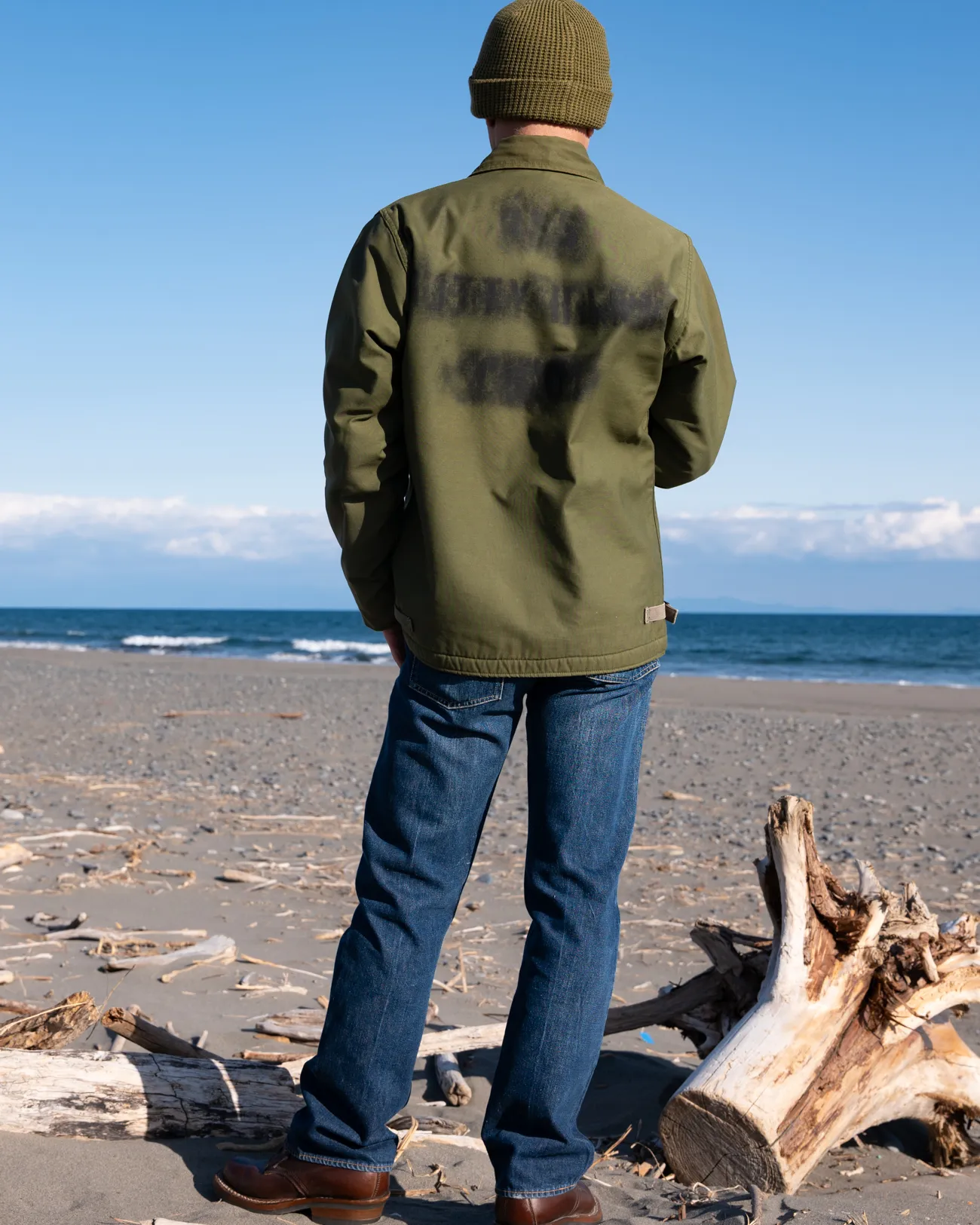
The volume of the 501XX leg is exactly right — it doesn't lose proportion against a bulky A2 deck jacket. The same holds with the M65.
Sartoria Formosa
Paired here with a bespoke cashmere jacket cut by Formosa — a master of Neapolitan sartorial culture.
A cashmere jacket from a Neapolitan master with European aristocratic culture in its DNA, alongside a vintage 501XX that began as American workwear — an unlikely combination on paper.
From a fashion-category standpoint, the two have nothing in common. Yet together they make a very strong impression. It reads within the Classico Italiano frame, so I complete the look with shoes to match — an open-lacing Derby from Marini, Rome's distinguished bespoke shoemaker.

Close in concept to the Brunello Cucinelli pairing — a well-cut piece from a different cultural tradition fits the body with a precision that makes it a natural partner for the orthodox silhouette of the 501XX. The aristocrat's prize and the working man's workhorse: a combination that might be called classless, in the best sense of the word. The depth of both pieces makes the silhouette they produce together something genuinely rare.
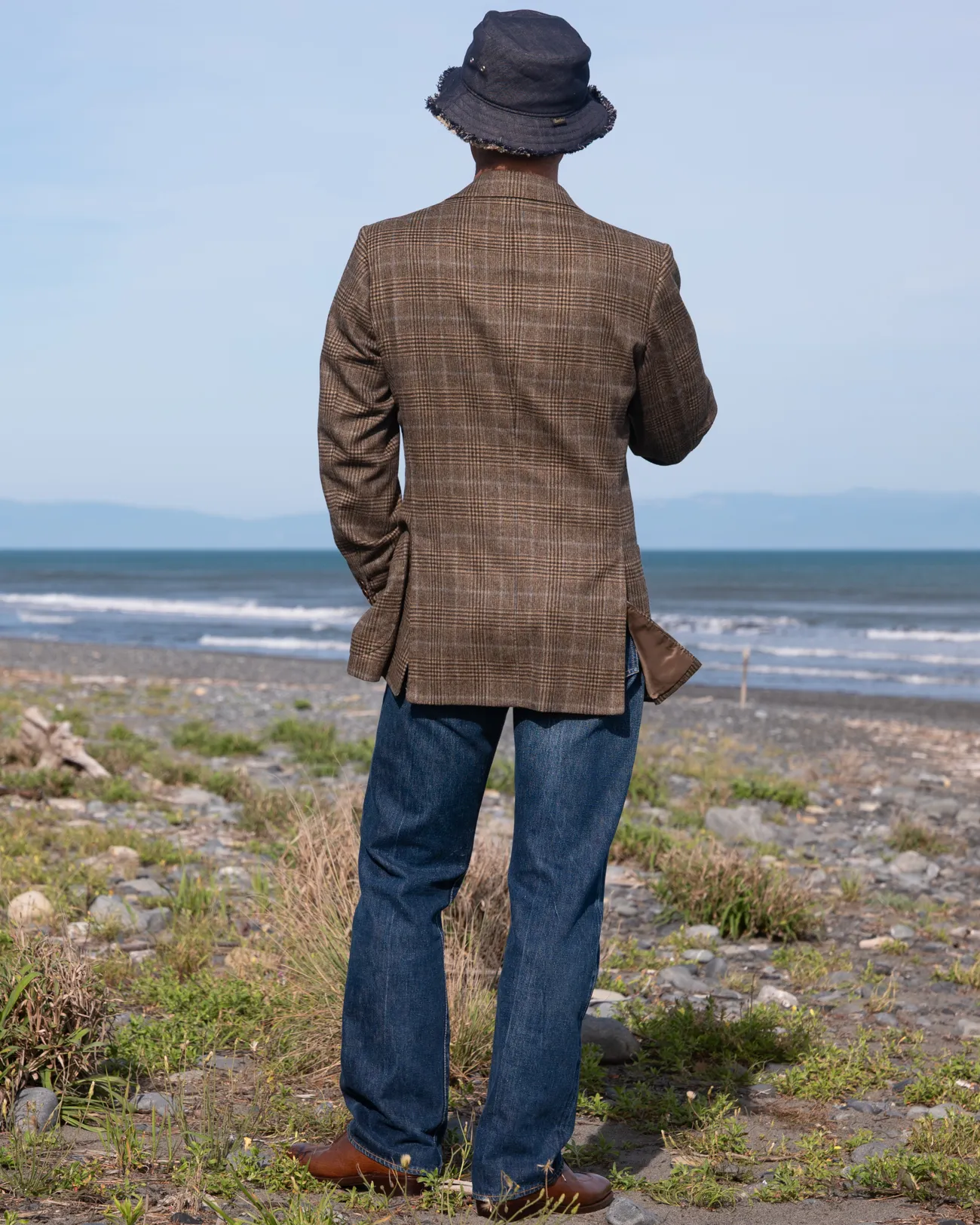
The clean line from the knee down sets off the jacket's cut — each piece bringing out the quality of the other.
A Lange & Soehne
Pairing Levi's with a Rolex sports model is a classic combination — but A. Lange & Söhne's Richard Lange works just as well.
The brand's name may conjure suit-and-tie formality, but the Richard Lange has its own logic for casual wear: it is an homage to the deck watch — a precision instrument built for astronomical observation — which places it in the same functional lineage as a Rolex Daytona. Its origins as a measuring instrument, rather than a dress watch, give it an affinity for informal contexts.
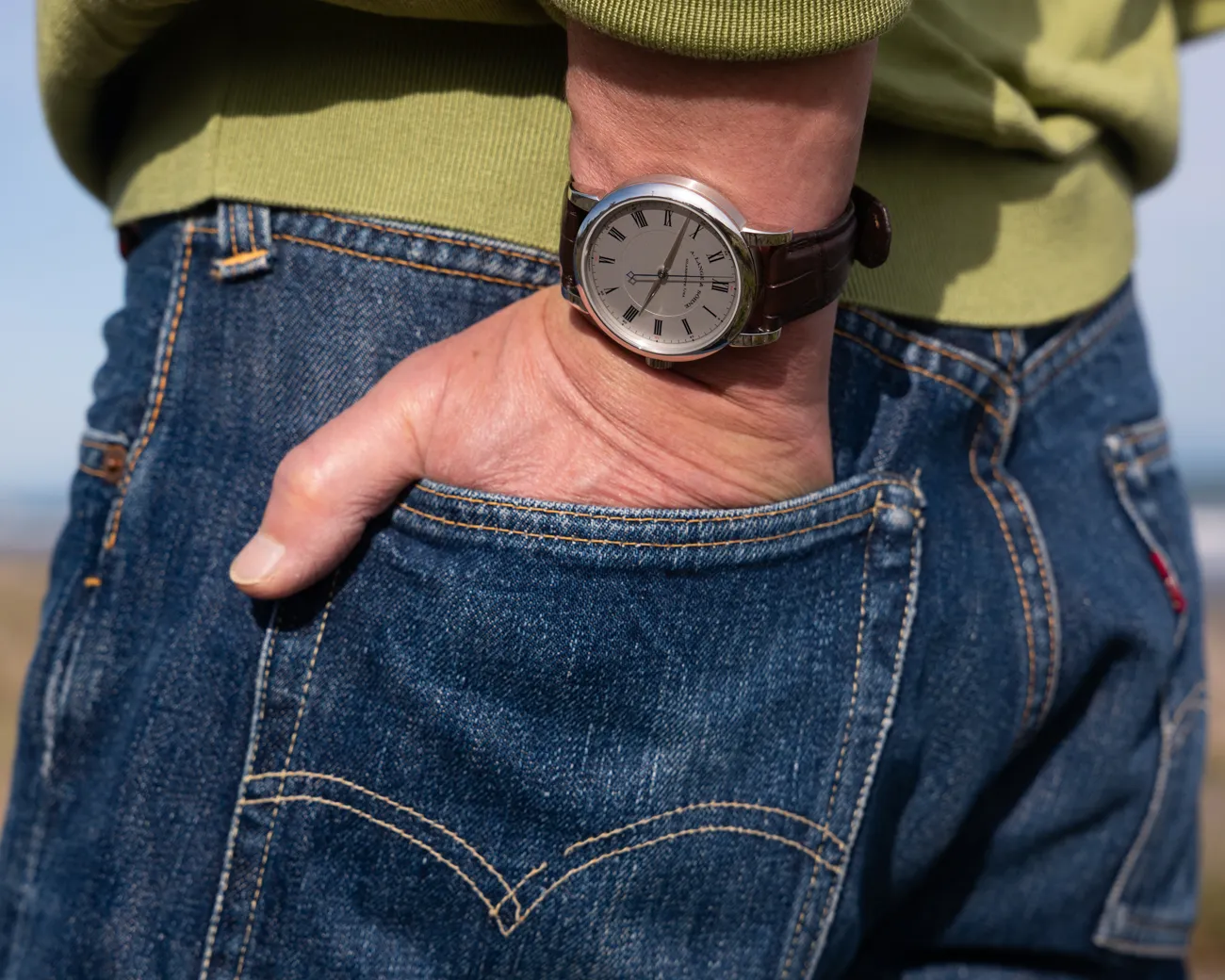
The depth of the indigo blue and the yellow stitching are among the 501XX's most distinctive qualities. Against a dark brown crocodile strap, the platinum case of the Richard Lange reads exactly right.
Details.
- Levi's 501XX 1954 model
- Leather patch (now lost)
- Centre belt loop
- Double-sided tab with ®
- Waist 30 in. / Length 32 in.
- No tears; hem unaltered; indigo well retained
What I Like
- A just-right fit
- A deep, strong indigo blue
- True of the 501 generally — the way the hip line reads when worn is very good
- Old as it is, the minimal damage means it works equally well with tailored jackets
- True of the 501 generally — the silhouette is clean, and wearing it makes you look well proportioned
What Gives Me Pause
- The inevitable loss of colour with each wash
- The price — finding one today means spending seriously
- The washing issue means summer — when I sweat — largely takes it out of rotation
- Everything is a one-off, which makes finding the right size a real search
Care
I wash my vintage jeans myself. Turn them inside out, fill the bath with water, dissolve a small amount of denim-specific detergent — or a gentle alternative such as Woolite or Emal — and press-wash gently, then leave to soak for a short time.
Rinse in the bath, remove the excess water with a towel, then dry flat in the shade. If the towel isn't enough to remove the water, fold the jeans into a laundry net and spin briefly before hanging.
I don't wear vintage jeans every day, so washing is infrequent. But leaving them unwashed out of excessive concern for colour loss actually accelerates deterioration through oil and grime build-up. I wash when I notice it's needed.
Conclude.
The 501 works with almost everything a man might wear: military pieces, T-shirts, shirts of any kind, tailored jackets, and in the colder months, rider's and flight leather jackets, stadium jackets, coats, heavy knits — the list is essentially complete, and nothing is excluded.
Within that, choosing a vintage 501 with a little history behind it has an effect: the other pieces you wear alongside it come alive, things you put on without much thought suddenly look considered, and you find yourself re-appreciating what you already own.
I prefer a just-right fit in a straight cut, so that's what I choose — but a size up, worn low on the hip, also looks excellent.
This article focuses on the 50s 501XX, but 60s and later examples are equally appealing. As with any vintage market, older and rarer commands a higher price — choosing a later year is a perfectly valid approach. I wear 90s-era 501s and 505s myself. (Still roughly thirty years old.)
Mechanical watches have found a wider audience in recent years, and more people are wearing them well. The 501 pairs brilliantly with a mechanical watch — whatever you're already wearing will look even better alongside it.
Building a wardrobe outward from a key piece you genuinely care about reveals a kind of personal identity through style that I think is one of the real pleasures of fashion. I want to keep finding and writing about pieces that sustain that kind of long-term attachment.
The 501XX is my key item — it's the centre of my wardrobe, and future articles will continue to explore what I reach for alongside it.
If this article has made anyone curious about the Levi's 501 — vintage or current — I'm glad.
Purchasing Store.
The 501XX introduced here came from Fake-a in Harajuku, Tokyo.
A well-established, widely known shop — no introduction needed. The quality and condition of the vintage pieces on offer is exceptional; collectors browsing the stock will find things that satisfy serious scrutiny. What sets the shop apart is a strong preference for undamaged pieces: 40s and 50s jeans with no significant wear, examples close to dead stock. The clothing outside of jeans meets the same standard — condition that would be remarkable even for a current-production piece. As an established specialist, pricing tends toward the higher end, but it reflects what you're getting, and the value is genuine. For a particular piece done right, this shop delivers.
My own 501XX shows what people mean when they talk about the strong indigo blue that appears as vintage denim fades — and the way it opens up is exactly the quality the shop's careful buying makes possible.
The owner has the look of a 1950s American delinquent who stepped directly out of a time machine — not someone who immediately invites a conversation. But he is genuinely approachable, with deep product knowledge and real attachment to what he sells; he will explain each piece carefully. His eye for fit and his ability to compare pieces on the rack are both reliable. You will leave with something you're satisfied with.
If you are looking for high-quality vintage clothing, a visit is worthwhile. I also bought a 50s Lee 101-Z and a 50s corduroy shirt here — pieces I'll cover in separate articles.
Fake-a is affiliated with BerBerJin, another well-known Harajuku vintage shop — the two share a website.