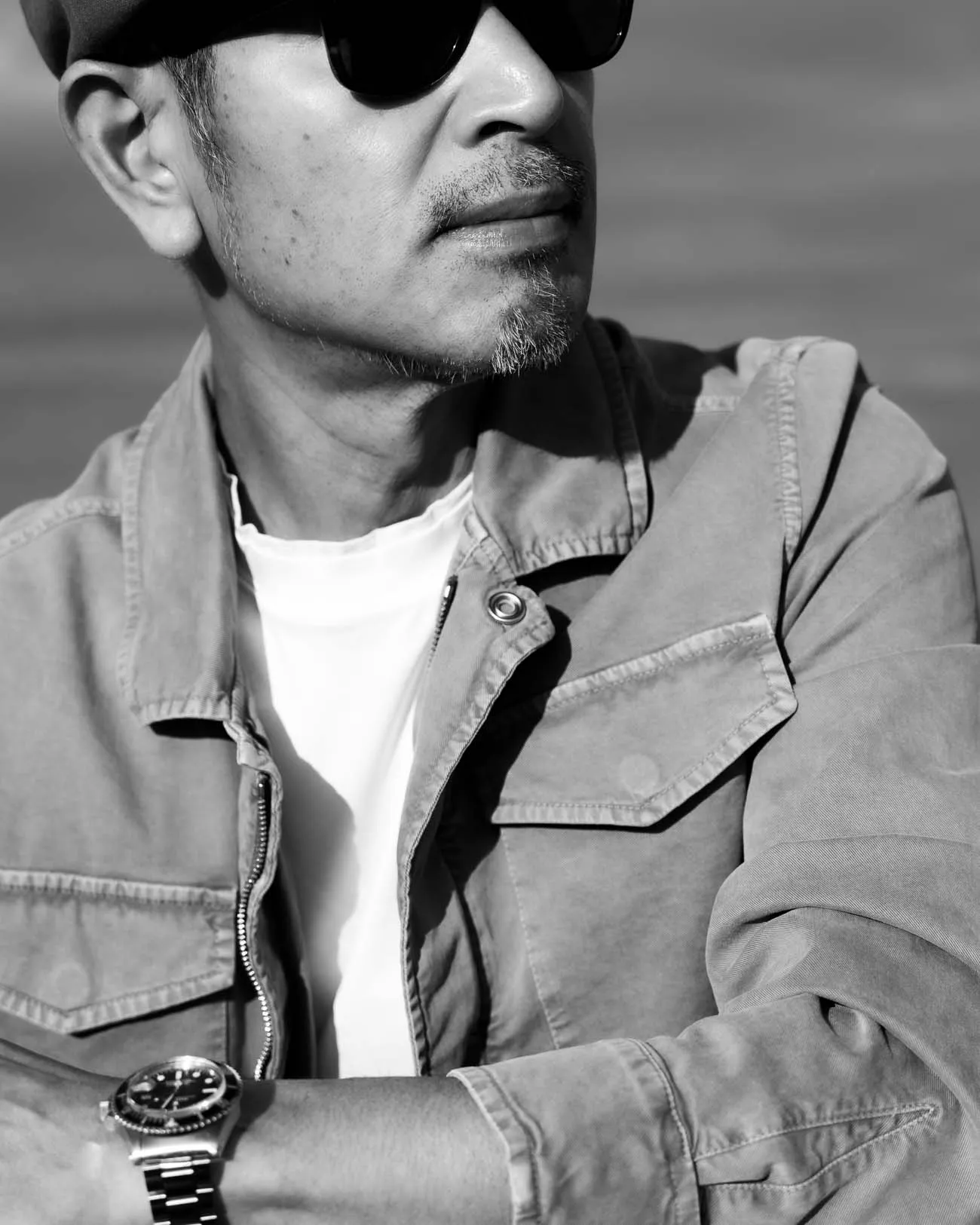
The name 'Interest' reflects the Japanese word kyōmi — curiosity, fascination with the world. I'm now in my fifties, heading toward sixty, and the name carries a quiet reminder to myself: don't lose that sense of curiosity as you grow older.
I also run a site called Hooked-on, built on WordPress. It covers life in my fifties, with fashion at the center — written from the perspective of someone living it.
Hooked-on.
The aim is to run a site that is fully original and one of a kind — photographing the things I own myself, wearing them myself, and writing about them from my own point of view.
"My approach to fashion leans toward pieces I can form a genuine attachment to — things built to last, where you can sense the intelligence and craft of the maker. I write from the perspective of how a man dresses, and dig into what fits my own sensibility and what I find to be genuinely universal." — from Hooked-on
"These aren't articles written to sell anything. I started writing because there was almost no information online about how someone who actually owns a piece enjoys it. Everything here is written from a deeply personal point of view." — from Hooked-on
That is the thinking behind the site. As for how to design and structure the content I create — how to deliver it — there are no right answers, and I'm still working through it by trial and error.
Wanting to extend beyond what WordPress could offer on Hooked-on, I chose Drupal and built Interest.
Interest is the fifth website I've built. (The second on Drupal.)
The aim with Interest is to think carefully about how a site is structured — how easy articles are to read, how easy they are to find.
Theme.
There are two broad content themes.
- I write primarily about web development under the label Drupal — documenting the things I've encountered building and running a site with it.
- I've ported the lifestyle articles originally written on WordPress, condensed and restructured under the label Life Style.
The site design is guided by the following:
- A simple, usable UI/UX
- Readability through typography and whitespace
- Built with the minimum technology necessary — nothing superfluous
- Minimizing display inconsistencies across viewing environments
- A structure that uses the relationships between content to help readers find what they're looking for
The design has a strong experimental element.
Drupal Articles
When I first started using Drupal, I looked up each feature and how to use it concretely. Basic descriptions and concept-level information exist in abundance. What they don't give you is the thing a beginner actually needs to know: where to use a feature, how to use it, and what happens as a result. Most of what's out there reads as developer-oriented tutorials.
- The information available about Drupal is aimed at developers. For a beginner, it doesn't connect to the actual process of building and publishing a site.
- Drupal is built for enterprise web projects. The people who work with it are mainly agency developers handling corporate work, and configuration knowledge tends to be treated as proprietary — which is part of why it doesn't flow into the open.
- Drupal's interface is structured so that to do A, you first have to configure B, C, and D. That architecture makes it difficult to document a single case in isolation.
- The biggest difference from WordPress is this: with WordPress, the person who builds the site and the person who uses it are often the same — so individuals share information openly. With Drupal, builder and end user are usually different people. The individual rarely gets the chance to publish what they know, and I think that's the core reason Drupal information is so scarce.
I use Drupal as an individual. I'd like to help fill that gap. The Drupal articles on this site include real examples wherever possible, with the goal of giving readers a concrete starting point for solving their own problems.
This also reflects something I feel about open source: a spirit of mutual support that I want to embody. Drupal is developed as OSS and distributed freely. Writing these articles is my way of expressing gratitude and respect for that.
The articles run long, and it can be difficult to take everything in at once. I hope you find something useful regardless.
Life Style Articles
These are ported from Hooked-on — but not simply copied over. The articles are condensed with mobile readability in mind. Photos are taken in portrait orientation as much as possible, using a 4:5 ratio (the proportions of large-format film) to suit the mobile environment.
I've used Drupal's taxonomy to build a kind of reverse-lookup structure: from brand to item, from shop to item, from item to related item. The aim is to create pathways that help readers follow their curiosity.
Drupal's ability to publish information across multiple dimensions lets me restructure these articles in ways that weren't possible with WordPress — making use of what Drupal does best.
Jamstack
With AI now widespread, attack tools have grown more sophisticated. The risk of running a CMS on a live server has increased compared to the past. Serving only static files — with no programs running on the server — is one way to reduce that risk and simplify management.
My sister site, Hooked-on, runs on WordPress. Xserver, the hosting provider, handles security diligently. As long as I stay alert on my end, the system-level security is in expert hands.
The combination of AWS and Drupal is a powerful environment, but security is entirely your own responsibility — it's not packaged the way Xserver is, and the management overhead grows accordingly. Switching to JamStack was my way of stepping back from that overhead.
The loose theme running through everything I write is this: what does it actually take to share information that is substantive and worth reading? That question leads to articles that are explanatory and long. They contain suggestions I didn't always put there intentionally — I hope you read between the lines and find something in them.
The reason I took on Drupal — a topic aimed at engineers — is that I believe engineers, above anyone else, should have output that gives tangible form to their goals. Creating content for publication always requires one step that can't be skipped: putting concrete cases into words.
When you articulate concrete cases, build the resulting content yourself, and run it — problems become visible that you simply cannot see otherwise. The habit of reading logs carefully, and a sharpened security awareness, follow naturally.
Running a site you've built end-to-end yourself deepens your understanding of what clients actually need and what the technical literature is really pointing at. I wrote this hoping that engineers who read these articles might come to see coding and design not as tasks to complete, but as one part of the process required to achieve something real — and that it might help broaden their perspective.
Many engineers think with exceptional rigor and logic. And yet engineers who can operate confidently on a global stage are still relatively few. I hope that changes — that more people step into that market and bring their skills with them.
Thank you.
Thank you for reading to the end. I hope you'll continue to explore the articles here.
'Wishing for a world where technology makes people's lives richer and more fulfilling.'
June 2026 Shinichiro Takeda