This article is a mobile-friendly adaptation of the piece I wrote for my sister site, Hooked-on: "New Balance 1700." If the subject interests you, I encourage you to visit the original on Hooked-on as well.
Images on this site are formatted for mobile in a vertical layout, which can appear oversized on a desktop screen. If that bothers you, the Hooked-on version may be easier to read.
[ https://en.hooked-on01.com ]
This site, inter-est, rebuilds content from my WordPress site Hooked-on using Drupal — and uses Drupal's features to enable cross-referencing between articles and browsing by related content. My hope is that visitors find their curiosity — their interest — expanding as they move through the site.
I've been wearing New Balance for over twenty years. On days off, sneakers are almost always what I reach for — and New Balance is the brand I keep coming back to.
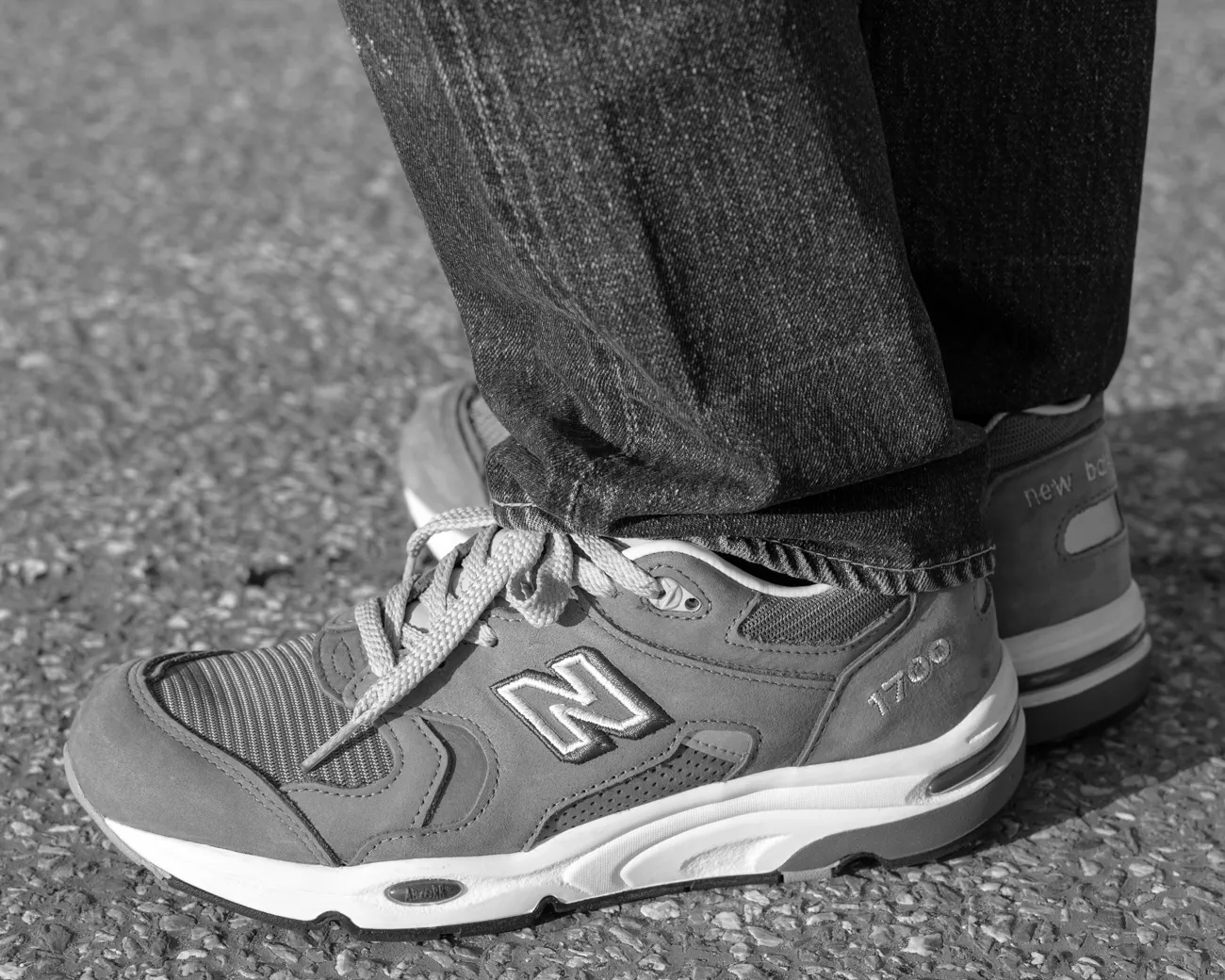
New Balance 1700 series.
New Balance is popular — you see them everywhere. I have a habit of buying three of anything I like, and New Balance is no exception: I keep three pairs in rotation at any given time. Sneakers inevitably wear out — the heel, the sole, the upper — and when the damage goes beyond repair, that's the end. But rotating three pairs extends the life of each one considerably.
My current rotation is the 1700 series I'm introducing here, along with two pairs from the 991 series — one beige, one grey.
998 series.
Before the current lineup, I wore the 998 series. When the sole and heel finally gave out, I went back to buy a replacement — and found it had been discontinued. The 1700, which is close in design, is what I moved to.
Small N logo.
My rule with New Balance is to buy the UK models — the ones with the smaller N logo.
It wasn't a deliberate decision at first. I used to buy regularly at Barneys New York, and the New Balance that select shops like Barneys stocked tended to be UK models. The smaller N is the detail I came to prefer, and I've stayed with the UK series ever since.
Construction.
What keeps me coming back to New Balance is straightforward: they're comfortable to walk in, the mesh upper breathes well, and the sole — both the material and the thickness — is well judged. You don't tire of wearing them. The benefits are easy to take for granted, which is exactly why I've found it difficult to commit to any other sneaker over the years.
The 1700 uses several of the design and technology elements that characterise New Balance across the range, including the cushioning that is one of the brand's defining qualities. It's a conservative model, but it works with almost anything — jeans, chinos, shorts.
Styling.
An orthodox sneaker goes with virtually any casual outfit. Jeans are the natural pairing, and a just-right inseam length tends to work better than anything cropped or long.
The combinations shown here are Boncoura 66 and a 1960s Levi's 502. The Boncoura 66 is close to rigid, worn with a zip hoodie. The 502 is heavily faded with a lot of repairs, worn with an M43 HBT field jacket. Different denim, different atmospheres — but jeans and sneakers is a relaxed, everyday combination that doesn't require much thought.
Boncoura 66.
A slightly tapered Boncoura 66 with a Ciota zip hoodie. Nothing unusual about the combination — that's the point. The grey 1700 reads as a good accent against the deep indigo of the near-rigid Boncoura 66.
The combination I reach for when running errands or going for a walk nearby.
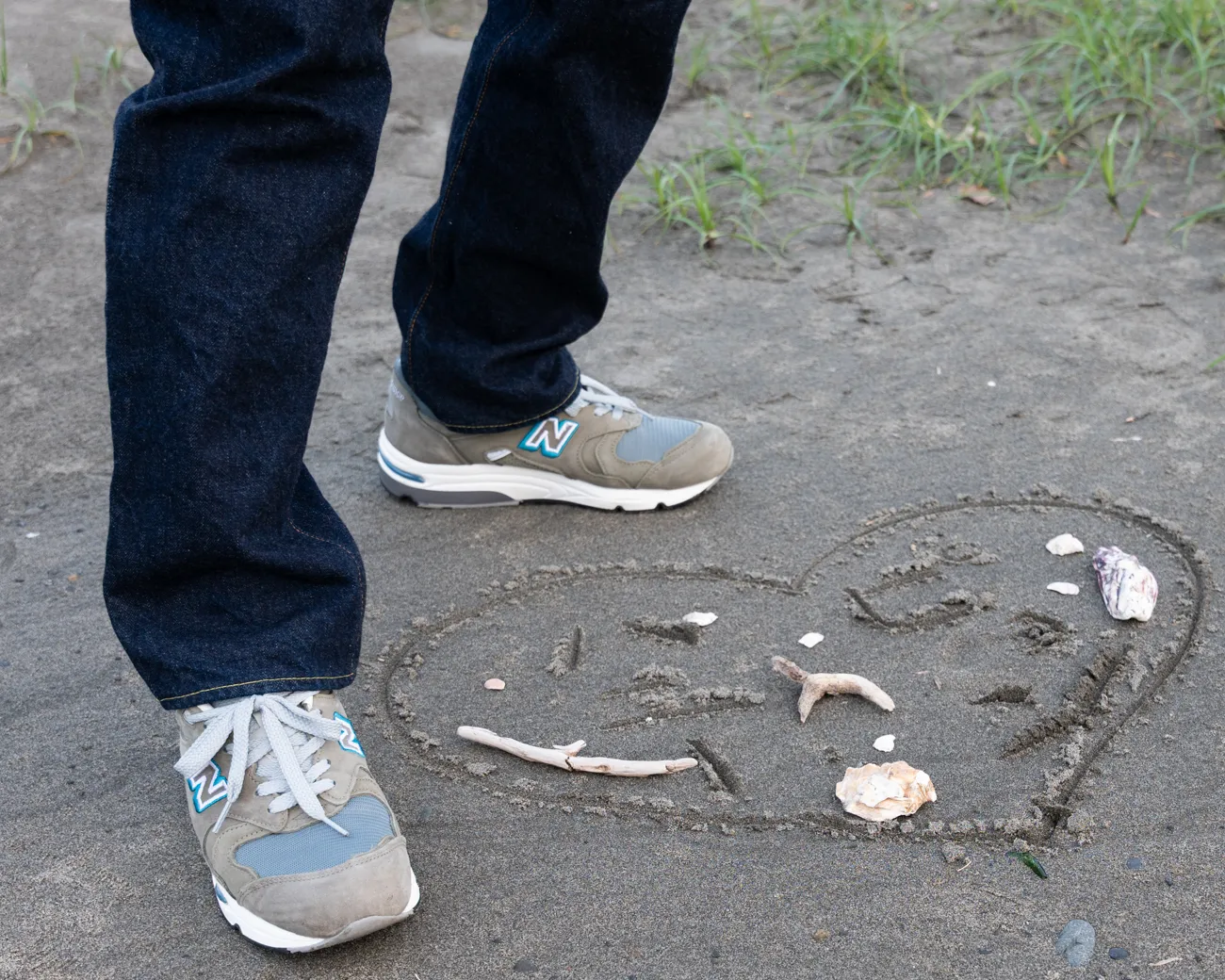
Some sand art caught my eye during the shoot — too good not to photograph.
The Ciota hooded zip sweatshirt, worn with the Boncoura 66. The lining is a traditional pile weave, which gives it a soft, lightweight feel — the kind of thing you pick up without thinking about it.

With the 1700 on the foot, the details of the Boncoura 66 come forward: the deep near-rigid indigo, the yellow stitching, the just-right inseam.
M43 HBT and Levi's 502.
The M43 HBT field jacket with a 1960s Levi's 502. Military outerwear usually calls for heavy boots — but this 502 is heavily faded and well repaired, and the 1700 at the bottom keeps the whole thing lighter and easier than boots would.

A relaxed American casual outfit. The sole volume of the 1700 — originally designed for running — turns out to be just the right proportion here.
Details.
- Pigskin suede and mesh combination upper
- Rubber sole
What I like.
- Excellent breathability from the mesh upper
- Comfort underfoot from a sole profile developed through genuine research
- A design that follows function — looks like what it is
- A classic design that hasn't changed in years
What gives me pause.
- The cushioned sole that makes them so comfortable to walk in works against you in a manual transmission car — the feel at the accelerator, brake, and clutch is less precise than with a flat, firm-soled shoe. You adapt, but it's noticeable at first.
- The same soft sole loses some pedalling efficiency on a road bike when riding without clipless pedals. Again, something you get used to.
Conclude.
The New Balance 1000-series began as a running shoe. The functional design has since crossed into fashion, and plenty of people wear them as a style choice. The drawbacks I've noted — the sole feel in a manual car, the pedalling loss on a road bike — are genuinely irrelevant to most people. For anyone without those specific concerns, this is a sneaker with no real weaknesses.
Purchasing Store.
I buy my New Balance at New Balance Roppongi 19:06, inside Tokyo Midtown. New Balance stores tend to be busy, but the Roppongi 19:06 location is manageable on a weekday — and the fitting staff there are knowledgeable enough to help you find the pair that actually suits your foot.
The official website is well stocked, and if you already know your size, online is a straightforward option.