This article is a mobile-friendly adaptation of the piece I wrote for my sister site, Hooked-on: "Levi's 501XX 1955." If the subject interests you, I encourage you to visit the original on Hooked-on as well.
Images on this site are formatted for mobile in a vertical layout, which can appear oversized on a desktop screen. If that bothers you, the Hooked-on version may be easier to read.
[ https://en.hooked-on01.com ]
This site, inter-est, rebuilds content from my WordPress site Hooked-on using Drupal — and uses Drupal's features to enable cross-referencing between articles and browsing by related content. My hope is that visitors find their curiosity — their interest — expanding as they move through the site.
As I noted in the 54 Model article, jeans are something I genuinely love — and the straight cut is what I keep coming back to. Of all of them, the Levi's 501 is my first choice, and I own more than one. The pair I reach for most often is the 501XX 55 Model, which is what this article is about.
The 54 Model has a 32-inch length, so I tend to wear it with boots or heeled loafers — with sneakers it runs a little long and needs to be rolled. The 55 Model, at 30.5 inches, hits the right length for sneakers and sandals. That's what I've been pairing it with, New Balance and others.
501XX 1955 Model.
Vintage 501s come in many variations, identified by their production period and the silhouette of the cut. The 55 Model introduced here was produced from 1955 through the mid-1960s — the last model to carry the 501XX designation, known among collectors as the paper patch era 501XX. My example is estimated by the shop where I bought it to be from around 1958.
"Paper patch era" is the name, but the paper patch itself is gone on almost every surviving example — including mine — washed away long ago. The model is identified instead by the details that characterise the paper patch period: the off-centre centre belt loop, the Big E double-sided tab, and the copper-plated rivets. What makes this model significant is that the 501 that followed it shifted, in response to the times, toward a tapered silhouette. The paper patch era 501XX is the last 501 to hold the original straight line — the last one that retains the workwear form and functional beauty the jeans were designed with.
The right size.
The reason I chose this particular pair was straightforward: it was my exact size. Waist 29.5 inches, length 30.5 inches — and since my other 501s run to 32 inches and work best with boots or heeled shoes, I'd been without a pair that worked properly with sneakers and sandals. That gap is what this one fills.
With vintage jeans, the age of the fabric means wear, damage, and repairs are part of the equation. This example has been tataki-repaired at the front buttons and around the knees — the areas that take the most stress — so I can wear it without worrying about the fabric. The length is original; the hem has never been altered, and the hem edge is clean.
The 501 with sneakers.
The outfits I reach for with this pair tend to be more casual than what I wear with the 54 Model — a down jacket and sneakers in winter rather than a tailored jacket; vintage corduroy shirts or moleskin workwear in spring; a simple white T-shirt and sneakers in summer. The pairings come naturally.
The repairs are done properly — each torn area tataki-stitched and solid — so I wear it without hesitation. The slightly shallow rise that characterises all 501s keeps the line through the hip and seat clean, which is one of the things that makes the silhouette look as good as it does.
The indigo isn't particularly deep, but it's faded the way denim fades through genuine wear — the blue is still clearly blue, the yellow stitching has softened to a pleasing tone, and the overall fade and patina is even rather than dramatic. Nothing about this pair fights with what you put with it.
Styling.
The length works with sneakers, so the pairings tend toward the casual. A 1950s corduroy shirt from the same era, or a moleskin jacket in autumn. In summer, a white T-shirt. The same decade, worn together.
50s Corduroy shirt.
Paired here with a vintage 1950s corduroy shirt. The same era worn together — it reads a little like stepping directly out of 1950s America. American casual shirts of this period often feature what collectors call a "loop collar" — a wide, open-neck style similar to what would be called an open-neck shirt in Japan — with the oversized collar that was characteristic of the time.
More historically American than "Americana" as a fashion category, but it's an easy outfit to wear — the kind of thing I find myself in from spring through early summer.
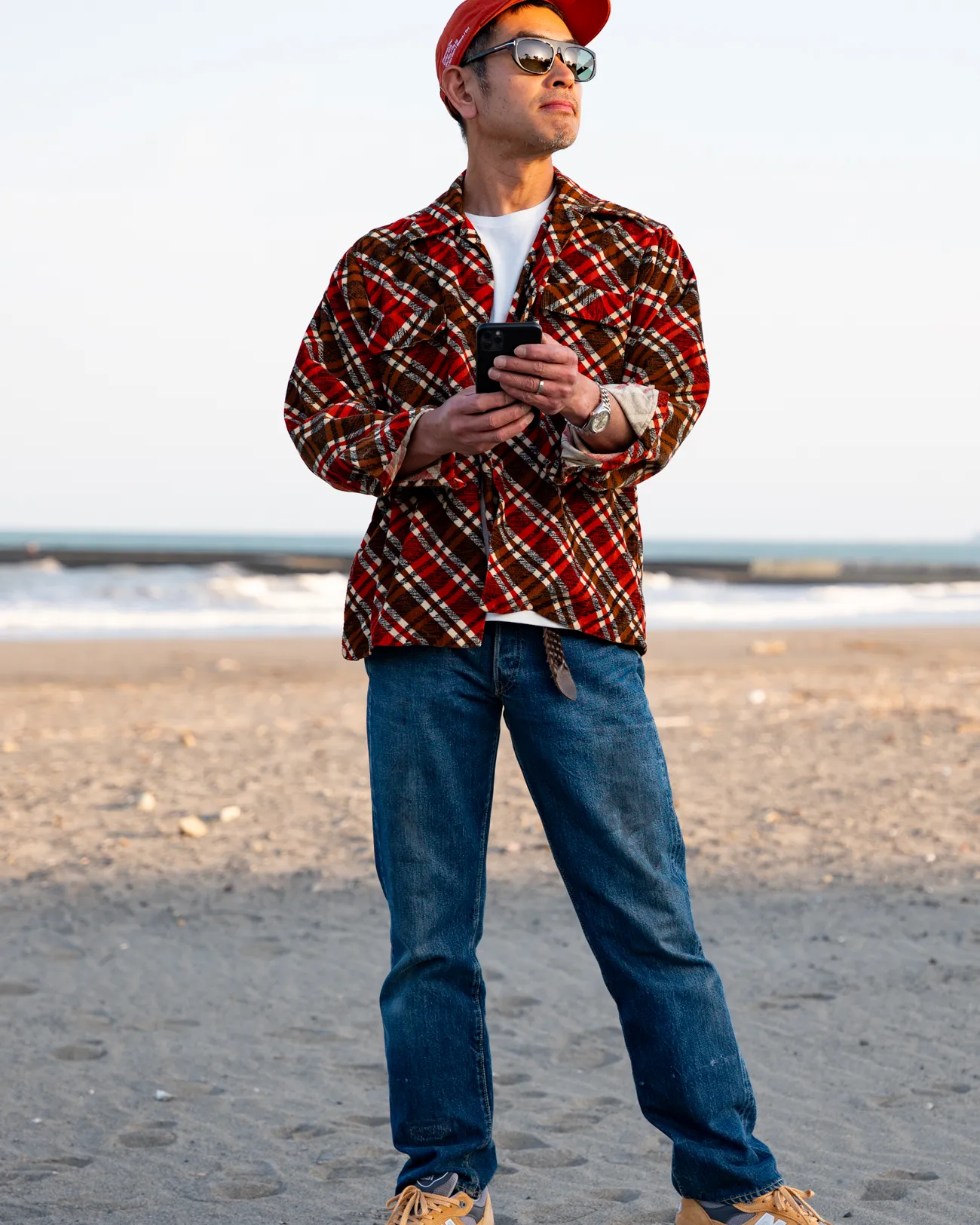
The indigo isn't heavy, but it's faded through wear — not washed out. It doesn't fight with anything.
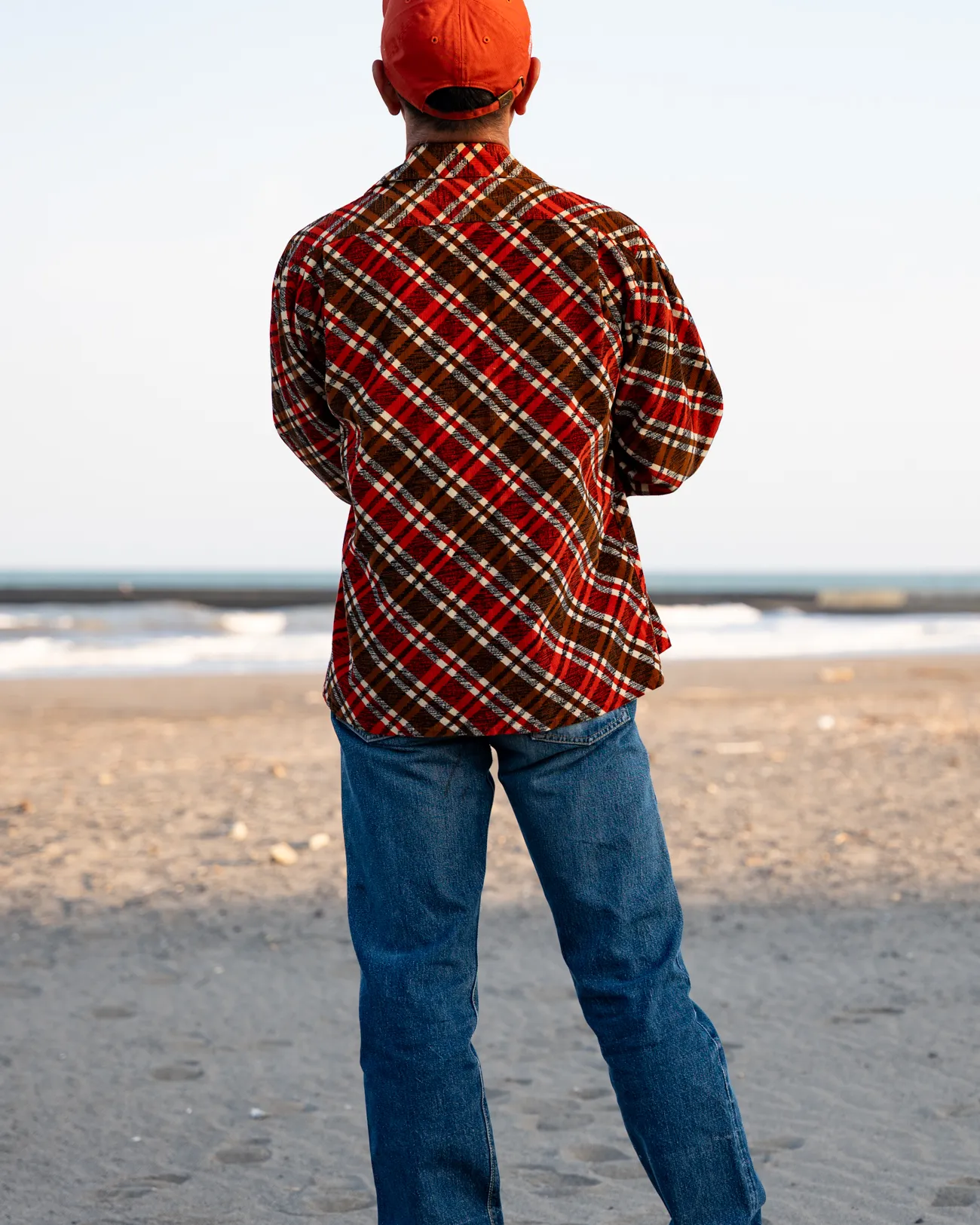
The 501 is something of a magic pair of jeans for how well it makes the wearer look — especially from behind, where the leg appears longer. Every brand that has ever respected and imitated the 501 has been chasing that same effect.
White T-Shirt.
The most straightforward pairing: a white T-shirt. Blue jeans and a white T-shirt is something close to an eternal truth in men's dressing. Worn here with a Wasaw pack T-shirt — their take on a Hanes-style basic. The weight, the fit, and the fabric are all exactly right. A clean, orthodox American outfit.
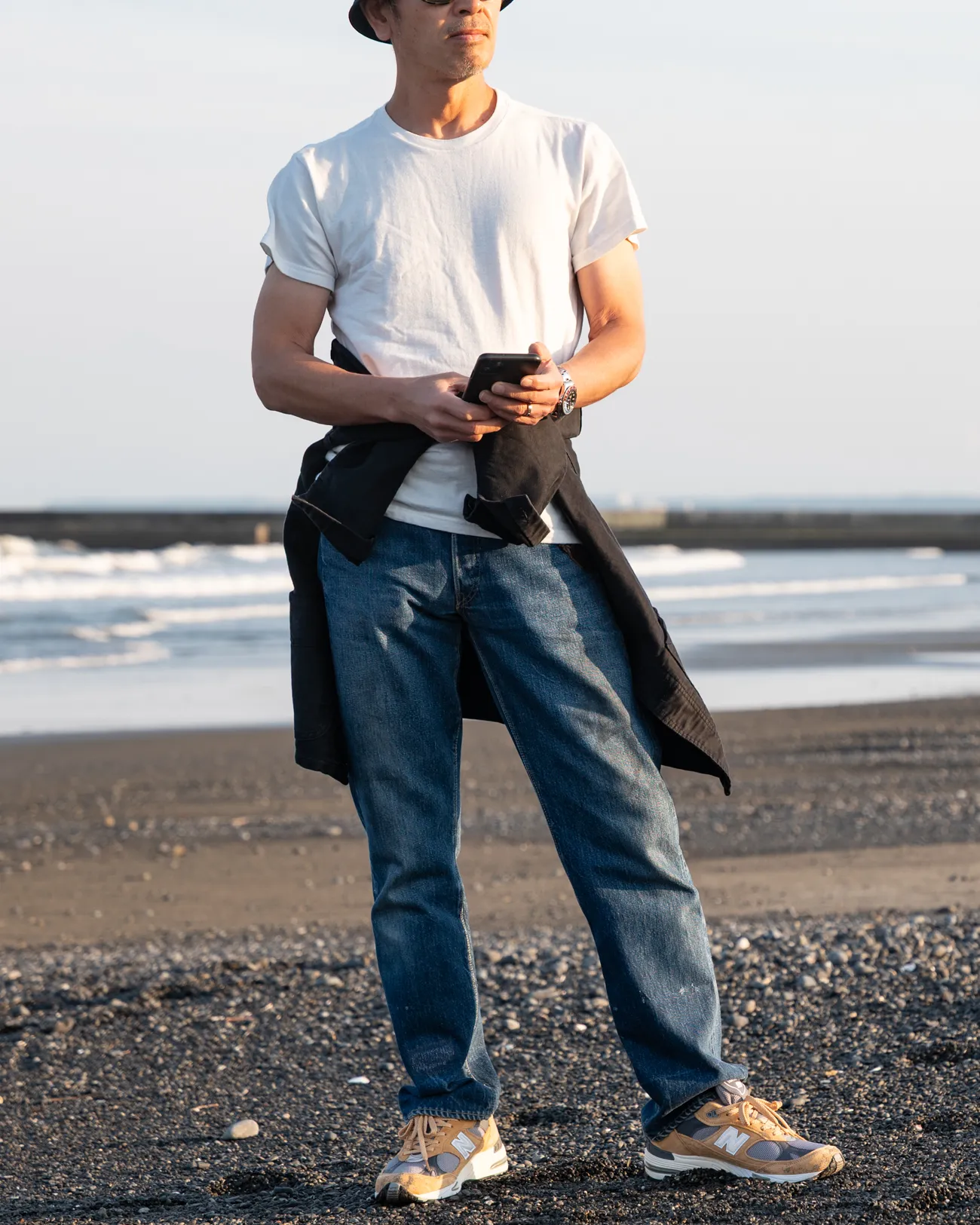
The length is right, the repairs and fade are part of the character, and the fit is as easy as jeans get.

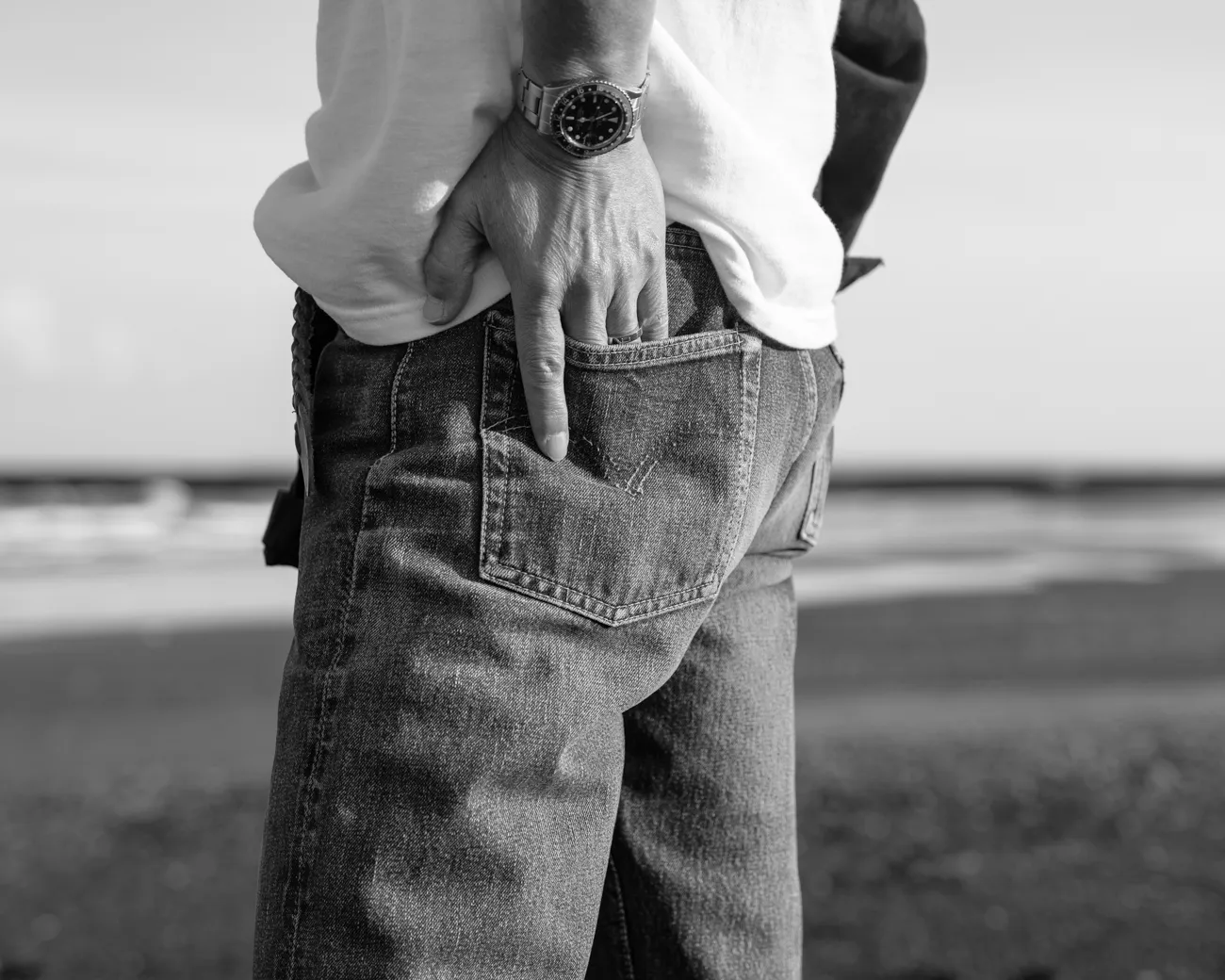
From the back, the absence of taper is clear. The straight silhouette ends here — every 501 that came after this model moved toward a tapered straight as the standard.
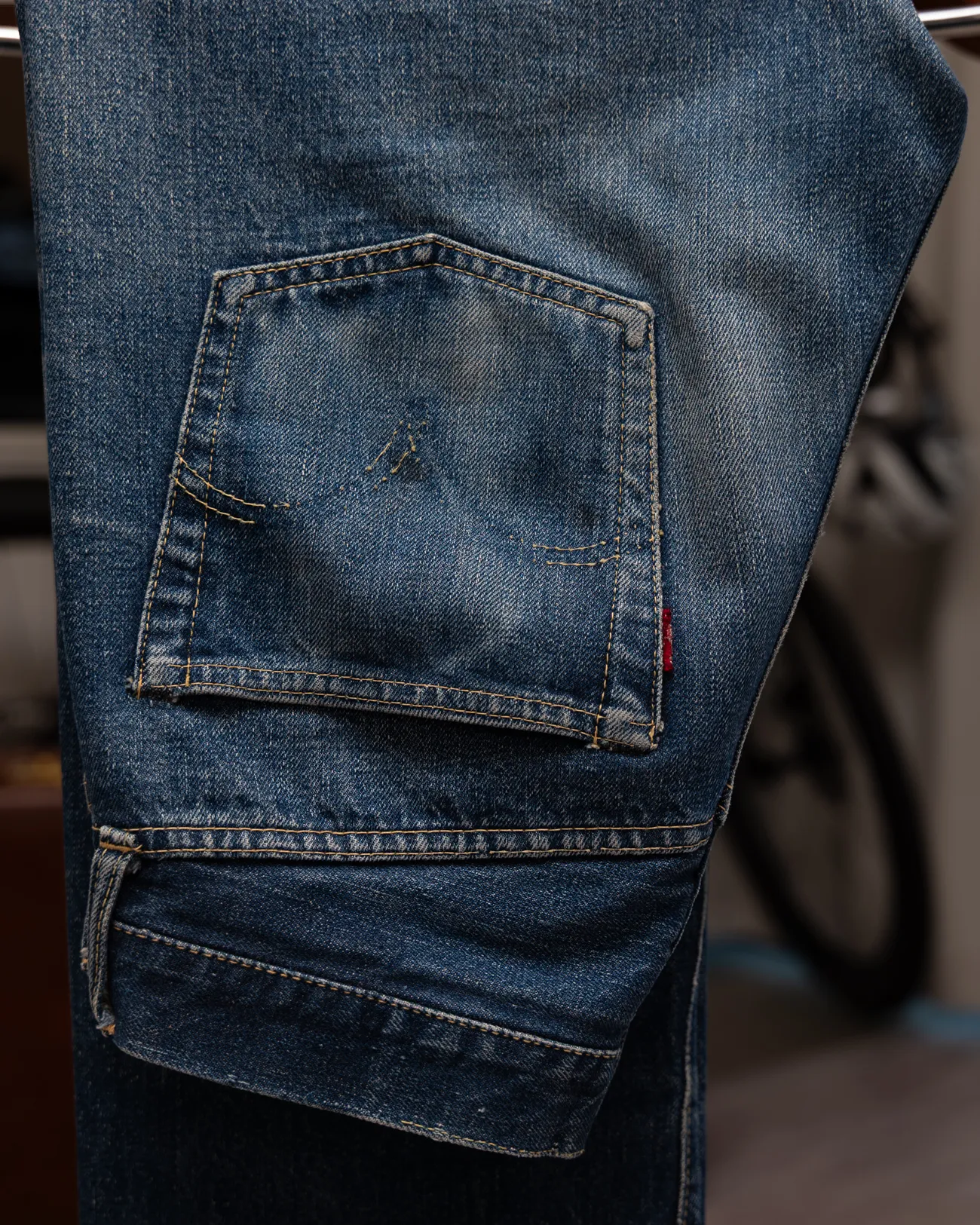
Yellow stitching and a red tab — the signatures of a 1950s 501XX. The paper patch is long gone.
Details.
- Levi's 501XX 1955 model
- Paper patch (now lost); off-centre centre belt loop
- Double-sided tab with ®
- Waist 29.5 in. / Length 30.5 in.
- Tataki repairs at torn areas; hem unaltered; indigo faded to a clean, even blue
What I like.
- A size that actually fits — waist, length, and all
- Indigo faded to exactly the right depth of blue
- The clean line through the hip — true of all 501s, but this pair does it well
- A length that works with any shoe — no compromises
- A silhouette that makes you look better — again, a 501 thing
What gives me pause.
- Fading with each wash — unavoidable, but worth thinking about
- Prices have risen considerably — good examples are not cheap
- Summer wear is limited — sweat and frequent washing accelerate fading
- Every piece is unique — finding one in the right size takes time
Care.
I wash my vintage jeans myself. I turn them inside out, fill the bathtub with cold water, dissolve a denim-specific detergent — or a gentle alternative such as Acron or Emal — and press-wash by hand, then let them soak briefly.
I rinse in the tub, blot out the excess moisture with a towel, and dry flat in the shade. If the fabric is still too wet after blotting, I fold the jeans into a laundry net and run a short, gentle spin before hanging.
I don't wear vintage jeans every day, so washing isn't frequent — but it's worth noting that avoiding washing out of concern for fading often causes more damage than the wash itself: oils and sweat left in the fabric degrade the fibres over time. I wash when I notice the jeans need it, and don't overthink it.
Conclude.
As I noted in the 54 Model article, the 501 goes with almost anything, which makes it genuinely versatile. But vintage pieces are one-offs — finding the right size and the right condition in the same pair takes patience.
I've been fortunate in that the pairs I own happened to be my size and in a condition I was happy with. With vintage jeans, antique watches, vintage guitars — the common thread is that searching patiently tends to lead to a result you're genuinely satisfied with. That's been my experience, at least.
One distinction worth making: vintage and antique objects are sold either as collectibles — where condition is the value, and use degrades that value — or as things to actually be worn and used. If your intention is to use what you buy, looking for pieces without strong collector value makes for a more enjoyable and more affordable search.
My own standard is use: I look for things I can wear, and I look for them on those terms. The appeal of vintage jeans, in particular, is that they were never designed as fashion. They were workwear — functional objects that accumulated their character through use and time. The functional beauty, the form, and the accumulated time can be approximated; the individual history of a specific pair cannot. That irreproducibility is what draws people to them, and I think it's why collectors around the world remain genuinely absorbed by them.
With vintage and antique objects, value is never absolute. Part of the pleasure is finding people and shops you trust — and building, over time, the relationships and judgment that let you buy with confidence and genuine satisfaction.
If this article has made the world of vintage and antiques feel a little less unfamiliar — a little more like something worth exploring, despite the inconveniences — I'm glad for it.
Purchasing Store.
My 501XX 55 Model came from Marvin's in Harajuku — a shop that needs no introduction in vintage denim circles, and has been one of the defining names in the field in Japan for years. The owner is one of the foremost authorities on vintage denim in the country, and the shop floor reflects that: genuine rarities alongside accessible everyday wearers, all displayed close together and organised by size, with tags on each piece noting the year and condition so you can judge price and sizing from the floor.
If something catches your eye, ask — fittings are available. The owner will explain the details of any piece in depth, including what the price reflects in terms of condition and provenance. At the point of purchase, he'll also walk you through washing, repair, and handling — the practical information you'll actually need once you get the jeans home.
Many pieces in the shop are there to be worn, and the necessary repairs have been properly done — tears and fraying addressed so you can wear the jeans without worrying about them. That's part of what makes Marvin's stock what it is.
Buying vintage denim for the first time can feel like a high barrier — starting with the question of which shop to trust. A long-established shop like Marvin's, where the stock is reliable and the knowledge behind it is genuine, is the kind of place where the experience of actually wearing what you buy becomes part of the reason you went looking in the first place.