
This article is a mobile-friendly adaptation of the piece I wrote for my sister site, Hooked-on: "CIOTA." If the subject interests you, I encourage you to visit the original on Hooked-on as well.
Images on this site are formatted for mobile in a vertical layout, which can appear oversized on a desktop screen. If that bothers you, the Hooked-on version may be easier to read.
[ https://en.hooked-on01.com ]
This site, inter-est, rebuilds content from my WordPress site Hooked-on using Drupal — and uses Drupal's features to enable cross-referencing between articles and browsing by related content. My hope is that visitors find their curiosity — their interest — expanding as they move through the site.
Japanese manufacturing is extraordinary — high quality is a given, and that standard carries through to clothing that takes vintage as its reference. The CIOTA jeans introduced here draw on the 66-series Levi's 501 as their model: a tapered straight cut with an indigo dyeing process that CIOTA cares about deeply. The result is a jeans that captures the feel of a well-worn 501 66 with a remarkable degree of accuracy.
When I photographed them alongside the 501XX, the blue of the indigo fade was close enough to be difficult to distinguish — the attention to detail is at that level. The world CIOTA is building is one where you can reach for a pair that looks and feels like a great vintage find, without any of the self-consciousness that usually comes with it.
CIOTA.
When the staff member who introduced me to CIOTA walked me through the brand, what stayed with me was this: the brand cares deeply about how things are made, but doesn't put that care on display — the result is clothing you can wear without any particular effort or self-consciousness, and that ease is actually part of the concept. The shop's own buying philosophy follows the same line.
I also learned that CIOTA's reference point is the way students and young people dressed in the mid-1980s — casually, without treating their clothes as statements. Looking at the rest of the range with that in mind, the pieces fall into place: a white cotton poplin shirt, an unlined navy cotton jacket, a slightly loose hoodie — all things that feel familiar and lived-in when you see them.
1980's Fashion.
That era comes back to me now through Popeye magazine — the look they promoted then was a 501, a white shirt, a navy blazer, and tassel loafers, and the image they built it around was Paul Weller. At the time, a 501 was just a 501 — new or secondhand (no one was thinking "vintage"), worn because of what it looked like, not because of what year it was made. The market that exists now, with its careful distinctions between eras and details, didn't exist.
Looking back, I understand now what was happening: without that market infrastructure, people chose a 501 for how it looked and how it fit into what the moment wanted. The decade before, the 1970s — all flares and boot cuts, as fashion chased the counterculture — the choice of the straight-leg 501 was itself a statement, one that only makes sense in retrospect.
Years later, working at a major select shop, I was talking with a colleague known for his sales instincts when the Paul Weller story came up. It turned out that the person behind Weller's look — the one who had him dressed that way — was the future head of a major select shop, then working at an ad agency. The approach was identical to what is now called influencer marketing: build an aspirational image around a person young people admire, promote the image rather than the product directly, and let the product follow. That this was being done in the late 1980s in Japan was something of a revelation.
Effortless vintage.
CIOTA's jeans take a deeply considered approach to indigo dyeing and construction — the kind of detail that would satisfy a serious denim enthusiast — but frame it around an era when those details weren't the point. The result is a pair that, on close inspection, reveals layers of craft, while wearing like something you simply reached for without thinking.
That quality — effortless to wear, quietly considered in every detail — is what makes them so useful. I wear them through the summer without worrying about washing. They get a lot of use. I should add: "effortless" doesn't mean ordinary. When I photographed myself wearing them, I found they held their own alongside the 501XX and the Lee 101-Z. A genuinely good pair of jeans.
Styling.
An orthodox cut, close in silhouette to the Levi's 66 series — it works with almost anything. The feel is close to the 1950s 501XX (paper patch era) that I wear regularly, so I tend to combine it with sneakers, T-shirts, and hooded zip sweatshirts.
[ Levi's 501XX 1954 ] : The leather patch era 501XX
[ Levi's 501XX 1955 ] : The paper patch era 501XX
Worn here with a Wasew white T-shirt — their take on a Hanes-style basic, also made in Okayama.

Blue jeans and a white T-shirt — as simple as it gets. But the depth of the indigo gives the combination a character that reveals itself on closer inspection.

A clean silhouette from the back as well.

Paired with a CIOTA classic pile-weave zip hoodie. With New Balance 1700 at the foot, this is the combination I reach for on errands or a walk nearby.
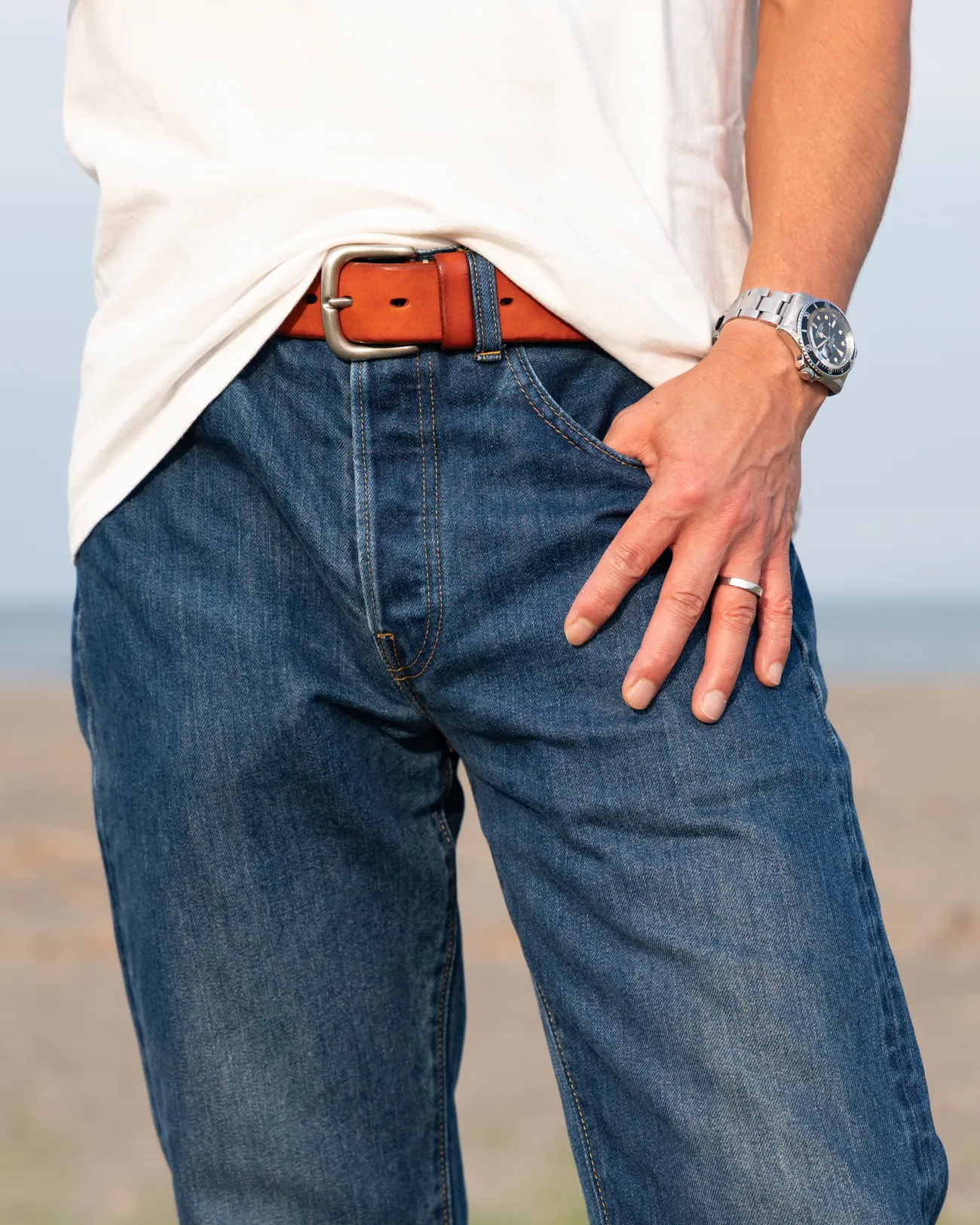
Okayama denim at its best — the quality of construction is evident the moment you handle them.
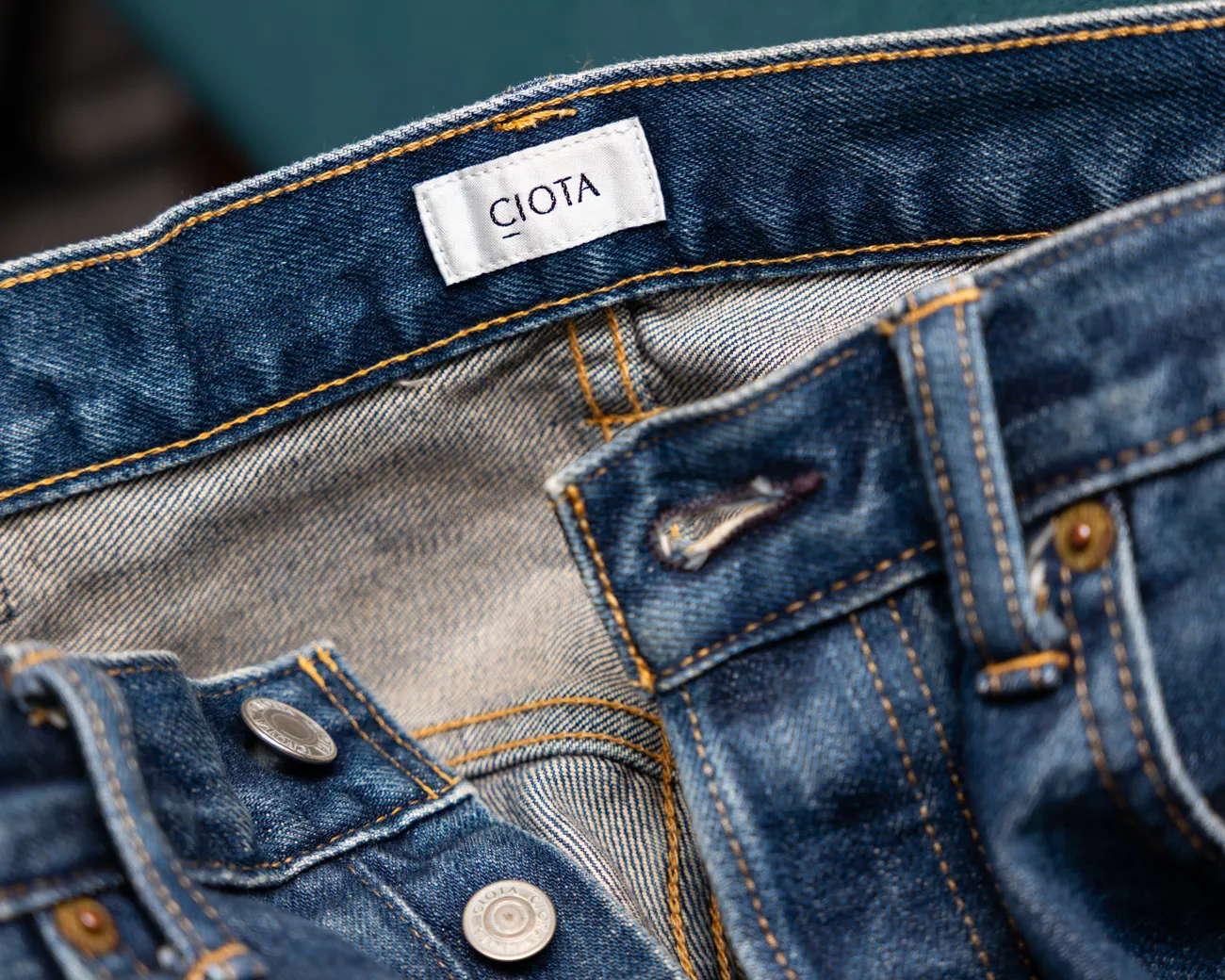
CIOTA Tapered 5 Pocket Pants (Real Indigo). The silhouette references the 1980s, but the fabric, dye, and hardware reflect a careful study of vintage originals and a considered modern interpretation.
Details.
- Warp: natural indigo rope-dyed, core-white yarn
- Weft: Suvin cotton — an extra-long staple, fine-count cotton
- Woven on a vintage shuttle loom — selvedge denim
- Button fly
Coordination.
- Hoodie: CIOTA
- T-shirt: Wasew, size M
- Denim: CIOTA Tapered 5 Pocket Pants (Real Indigo) — Waist 30 in. / Length 32 in.
- Shoes: New Balance 1700
- Hat: Fresh Service
- Watch: Rolex Submariner 1680 (1972)
- Sunglasses: Ray-Ban Wayfarer, 1990s (BAUSCH+LOMB)
- Belt: The Real McCoy's
Conclude.
CIOTA is not Levi's or Lee, not a European brand — it's a small Japanese label. But it applies everything that Japanese manufacturing does well to a vintage sensibility that has been updated for now. The designer's approach is one of deep respect for the past, genuine care in construction, and a deliberate choice not to put any of that on display — the result is clothing with a considered vintage feel that is rarer than it sounds.
Because it doesn't announce itself as a special pair of jeans, I reach for it regularly — through summer, without worrying about the wash. The same philosophy runs through everything CIOTA makes: T-shirts, shirts, jackets, hoodies — all referencing American vintage icons, all made with the same quiet care and the same ease of wear. Equally at home on a neighbourhood errand or a regular day out.
Purchasing Store.
About the Shop
The CIOTA jeans introduced here came from TF, a select shop in Tokyo. TF's buying philosophy mirrors CIOTA's own: clothing made with real care, worn without effort — everyday pieces that don't need to announce themselves.
The shop sits along a street wide enough to feel unhurried — not the dense, crowded atmosphere of central Tokyo shopping streets. The pace of browsing there reflects that.
A neighbourhood shop with character.
The staff are easy to talk with and know their stock thoroughly — the shop is small enough that every piece has been chosen deliberately, and any question about any item gets a proper answer. Pieces that look straightforward on the rack often reveal their quality when you pick them up or try them on. That gap between first impression and closer look is characteristic of what TF stocks.
The pleasure of Made in Japan.
The selection centres on domestic brands — basics with considered detail and a quiet twist, nothing that tries too hard. If you're looking for everyday clothing with understated good taste, this is the shop. I've bought the CIOTA jeans and hoodie here, as well as a CIOTA white shirt and navy jacket, a Paraboot Chambord in light brown suede (a TF exclusive), and a pair of SUNY glasses.
One detail worth mentioning: the shop's name, TF, comes from the tenant that occupied the space before — a tofu shop. It's the kind of origin story that says something about the people running the place.