
This article is a mobile-friendly adaptation of the piece I wrote for my sister site, Hooked-on: "US ARMY M43 HBT Field Jacket." If the subject interests you, I encourage you to visit the original on Hooked-on as well.
Images on this site are formatted for mobile in a vertical layout, which can appear oversized on a desktop screen. If that bothers you, the Hooked-on version may be easier to read.
[ https://en.hooked-on01.com ]
This site, inter-est, rebuilds content from my WordPress site Hooked-on using Drupal — and uses Drupal's features to enable cross-referencing between articles and browsing by related content. My hope is that visitors find their curiosity — their interest — expanding as they move through the site.
I have a fondness for US military clothing — the unlined M43 for spring and summer, the lined M65 for autumn and winter. This article covers the M43, which sees the most use in the warmer months. Made from cotton herringbone twill, it develops a distinctive character with age and pairs exceptionally well with vintage jeans and summer shorts.
M43 HBT Field Jacket.
Among people who wear vintage clothing, US Army pieces have a strong following — and of those, the M65 is probably the best known. The M43 introduced here is a field jacket issued to the US Army during the Second World War in the 1940s. HBT stands for herringbone twill — the cotton herringbone twill fabric the jacket is made from, which is where the name comes from.
Unlined construction.
The M65 has a lining, a dedicated inner jacket, and a longer body length — which makes it primarily an autumn and winter piece. The M43 is unlined, cut shorter, and worn as a single layer — so it doesn't get as warm as the M65 and works well through spring and summer, worn more like a heavier shirt than an outerwear layer.
The silhouette is distinctive: two large chest pockets, no side pockets. The cotton herringbone fabric develops a character all its own with wear. Designed for military use, the body width and armholes are generous enough to layer over base layers in cold conditions — which gives it a slightly loose feel by today's standards. But the shorter length means it works with almost any trouser, and it's been one of my most-used pieces through spring and summer.
Herringbone.
The herringbone fabric ages in a way that's hard to describe — it develops a texture and character that looks exactly right with worn-in jeans. I tend to pair it with heavily faded denim rather than dark indigo, worn casually. In summer I often tie it around my waist during the day and pull it on in the evening when the temperature drops. The short length also makes it work well with sleeves rolled and worn over shorts.
This is a piece built purely for function, used hard in actual military service, and aged into something with its own functional beauty — which is why I wear it often while still taking care of it. As I cover in a separate article, the contrast with the French M47 from the same period is genuinely interesting — the differences in national character and clothing culture come through in the garments, and wearing them side by side makes those differences tangible.
Styling.
The wear and fading on the herringbone fabric means it pairs better with jeans that have some history of their own — heavy fading, repairs. Shown here with a 1960s Levi's 502, heavily faded with multiple repairs, and New Balance 1700. The inner layer is a Brunello Cucinelli slim-fit white crew-neck T-shirt — a clean silhouette underneath. The M43 tied around the waist still makes for a good-looking outfit.
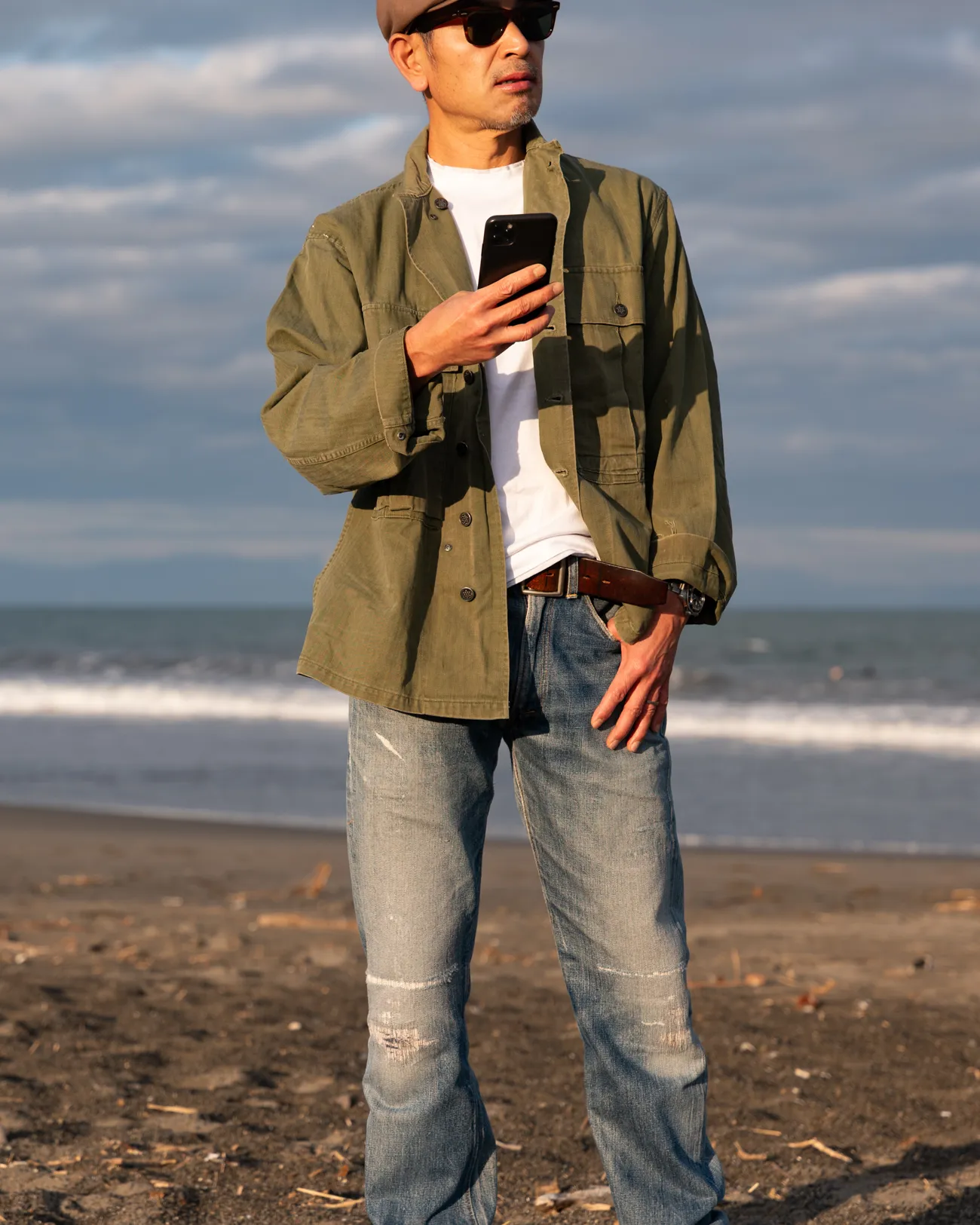
Worn with a 1960s Levi's 502 — heavily faded, with plenty of repairs. The wear on the M43 matches the energy of the denim; the overall balance holds together.

Genuine military — the armholes are cut generously. I tend to wear it with the sleeves rolled slightly.
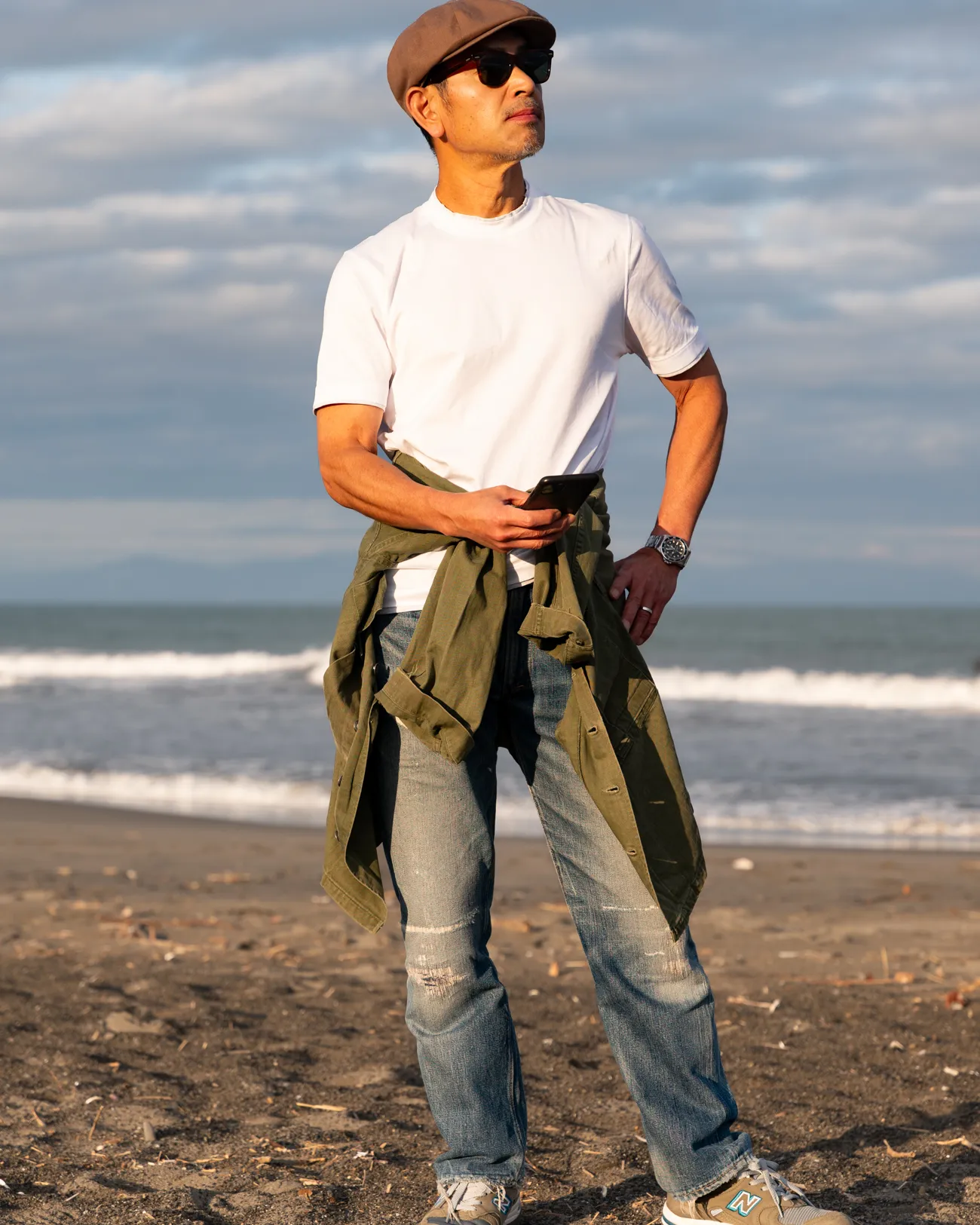
Most useful in early summer and early autumn, when the temperature shifts between day and evening. When it gets warm, it comes off and goes around the waist.
Details.
- 100% cotton (herringbone twill)
- Box silhouette, standard (A) military fit
- Shoulder width, body width, and armholes with comfortable room
- Sleeve and body length neither long nor short — an easy silhouette to work with
Coordination.
- M43 HBT Field Jacket: Size 38
- Denim: Levi's 502, 1960s — Waist 30 in. / Length 31 in.
- Crew-neck T-shirt: Brunello Cucinelli Slim Fit T-Shirt
- Hat: COMES AND GOES
- Watch: Rolex Submariner 1680 (1972)
- Sunglasses: Ray-Ban Wayfarer, 1990s (BAUSCH+LOMB)
- Belt: HTC
- New Balance 1700
Conclude.
The M43 works as a field jacket, but the more useful way to think about it is as a heavier shirt — that framing opens up more possibilities for how to wear it. It's a genuine military piece, so harder, more worn-in styling is its natural territory. But it also works alongside cleaner items; the combination comes together with a quiet authority rather than looking out of place.
The M43 is less common than the M65 — not rare exactly, but depending on when you look, good examples can be surprisingly difficult to find. My approach is to monitor vintage dealers online, and when stock appears, go and see it in person. If the size and condition are right, buy it. Searching patiently tends to lead to the right piece.