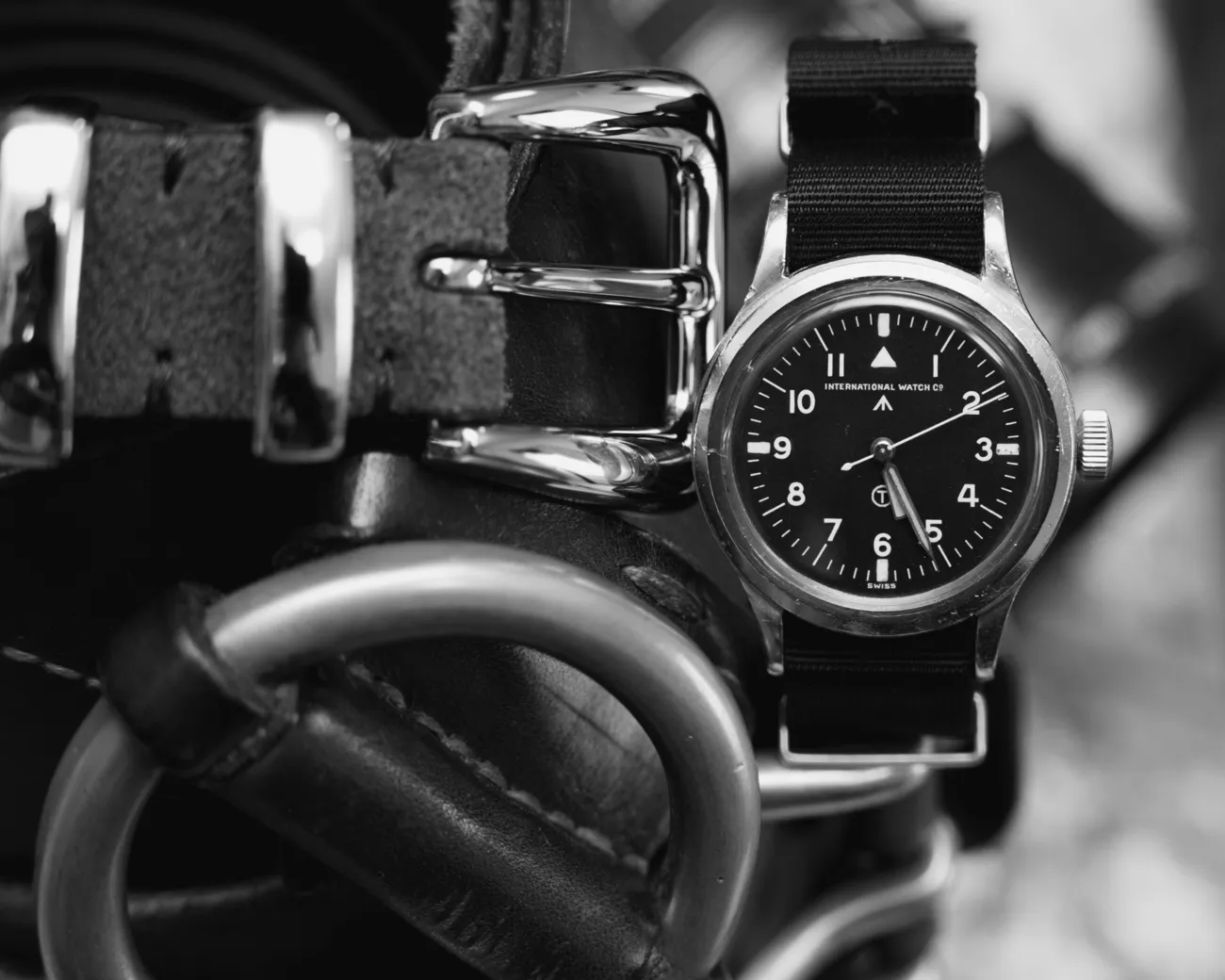
This article is a mobile-friendly adaptation of the piece I wrote for my sister site, Hooked-on: "IWC Mark 11 RAF." If the subject interests you, I encourage you to visit the original on Hooked-on as well.
Images on this site are formatted for mobile in a vertical layout, which can appear oversized on a desktop screen. If that bothers you, the Hooked-on version may be easier to read.
[ https://en.hooked-on01.com ]
This site, inter-est, rebuilds content from my WordPress site Hooked-on using Drupal — and uses Drupal's features to enable cross-referencing between articles and browsing by related content. My hope is that visitors find their curiosity — their interest — expanding as they move through the site.
The Mark 11 was commissioned by the British Ministry of Defence in the late 1940s and built by IWC (International Watch Co.) to genuine military specification. Two manufacturers were selected for the contract — IWC and Jaeger-LeCoultre — chosen for their ability to meet the required standards: high precision for aviation use, anti-magnetic and dust-resistant protection via a soft-iron inner case, and a highly legible black dial with Arabic numerals and luminous hands.
Made for use by the Royal Air Force, it is known as the RAF. During the war, twelve manufacturers supplied military watches to the British Ministry of Defence — those watches are collectively known as the Dirty Dozen, and each carries the Broad Arrow, the British government property mark. IWC had supplied the preceding Mark 10 to the Ministry during the war. The Mark 11 is the genuine RAF aviation watch that followed.
IWC Mark 11 RAF.
The Mark 11 introduced here was commissioned by the Royal Air Force in 1948 and built by IWC as an aviation instrument watch. Key specifications: anti-magnetic and dust-resistant protection via a double-case construction (soft-iron inner case), waterproofing, a highly legible black dial with white Arabic numerals and luminous paint, and the precision expected of an aviation timepiece.
My example carries the T mark — tritium luminous — but the 1948 examples were originally fitted with radium luminous, with the tritium conversion carried out from 1962 onward at the request of the RAF. (Some of this is inference.) Given that my piece was made in 1948, radium luminous would have been original, and the T mark is a later addition — which makes sense.
What drew me to the Mark 11 in the first place: it was purpose-built as a pilot's watch to military specification, which means the construction is genuinely robust; the black dial is simple and highly legible; it wears extremely well on a NATO strap (as it should — that's exactly what it was issued with); and I had always wanted a piece from the Mark series, having been a fan of IWC for some time.
Inner case.
The soft-iron inner case used for anti-magnetic protection is one of the technically interesting aspects of this watch — the same technology was later carried forward into the Ingenieur. And beyond the engineering, there are the stories: the history of the Dirty Dozen, the meaning of the Broad Arrow. The more you look into it, the more there is. That depth is part of the attraction.
IWC Mark series.
The Mark 11 remained in production from 1948 until 1981, when the British Ministry of Defence contract concluded, and continued in civilian production until 1984. It was supplied not only to the RAF but to the Royal Australian Air Force, Royal New Zealand Air Force, and South African Air Force, with civilian versions produced alongside. Production was eventually suspended, then resumed in 1994 with the Mark 12, continuing through to the current Mark 20. Among all of these, the Mark 11 — a watch actually built for military service — holds a particular appeal.
How I came to buy it.
The deciding factors were the people at the shop: good conversation, genuine knowledge, and the quality of the piece itself. With antique and vintage watches, wanting to buy from a specific person or shop is important — and this purchase met that condition.
The 36mm case is a genuinely useful size. The crown is large — deliberately so, for use with gloves — and easy to wind. The dial reads well. On a NATO strap, it sits comfortably on the wrist and works with a wide range of things: jeans, military outerwear, a single T-shirt. It gets a lot of use.
The generation before my Mark 11 — the wartime Dirty Dozen — has its own following. Some collectors seek a single favourite example; others pursue all twelve manufacturers. It's a category worth exploring if military watches interest you.
IWC doesn't have the same general recognition as Rolex — no one stops you on the street to ask about it. But when someone who knows does notice it, the conversation tends to go on for a while. That's its own kind of pleasure.
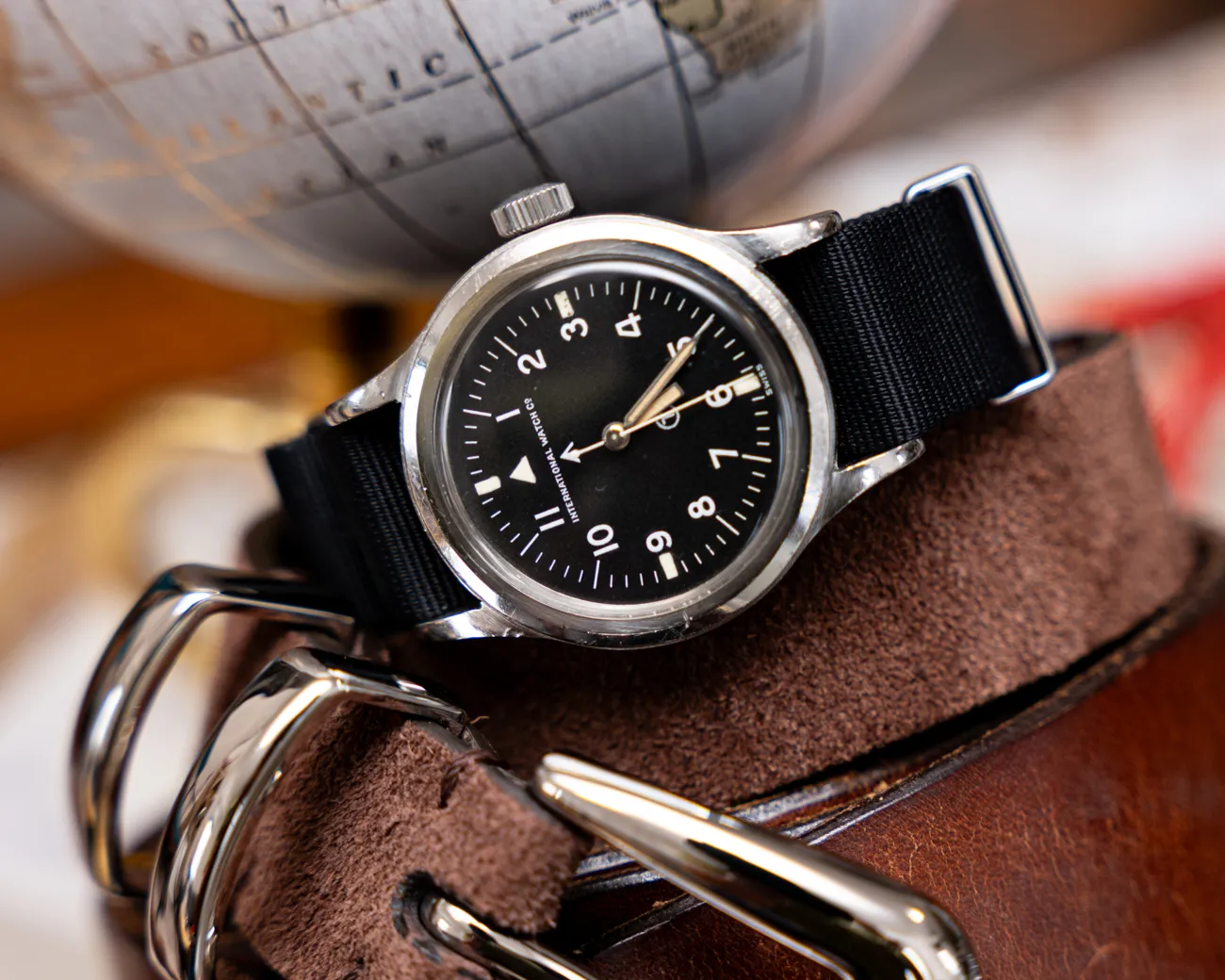
IWC Mark 11 RAF Royal Air Force
Styling.
Being a genuine military watch, I wear it most often with military clothing — M43 HBT, M47, M65. For denim, it pairs better with Lee than with Levi's, so it tends to go on when I'm wearing a 1950s Lee 101-Z.
M47 Field Jacket.
The combination I return to most is the M47 field jacket with a Lee 101-Z. The Mark 11 goes on for that.
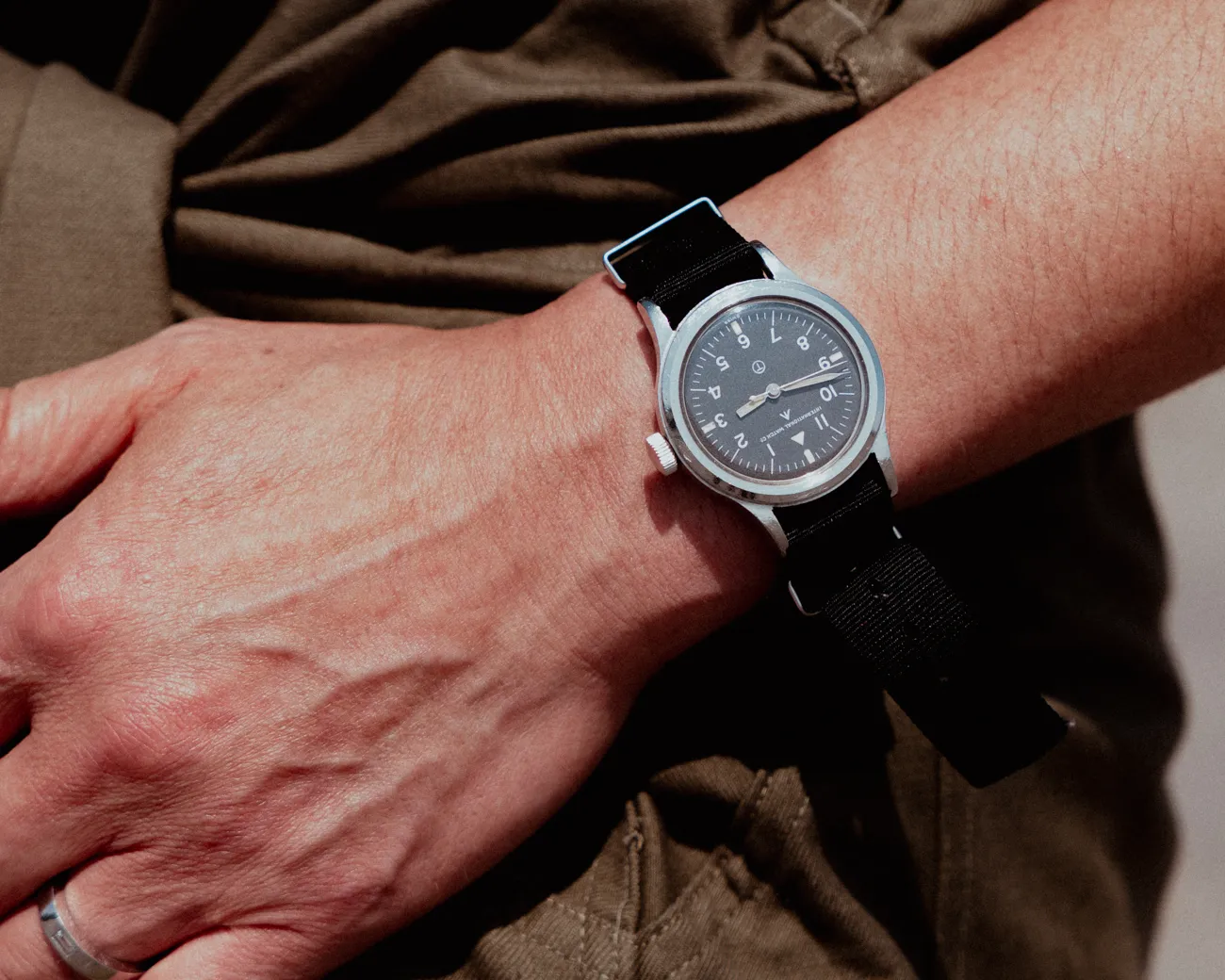
A genuine military watch with military clothing — the pairing needs no justification.
Lee 101-Z Black Tag.
With Lee, I tend to reach for something other than Rolex. The Mark 11 is the natural choice.
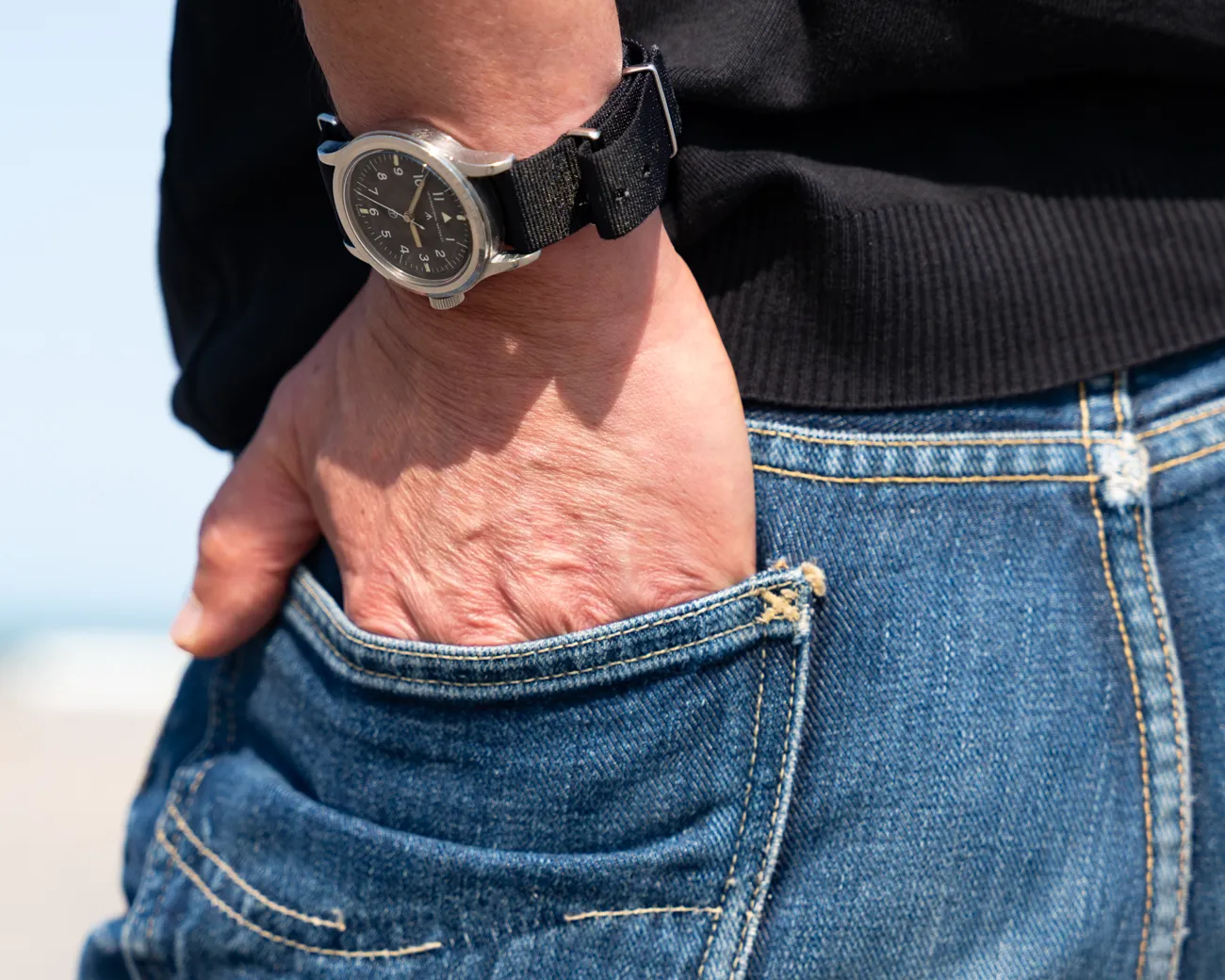
A practical note on the NATO strap: because the strap passes under the caseback rather than attaching to it, the watch doesn't sit directly against the skin. In summer, when perspiration is a concern, this removes any worry about moisture — a useful advantage with an older watch.
Details.
- Mark 11 (6B/346)
- Year: issued 1948; luminous later converted to tritium
- Case: stainless steel
- Strap: NATO (current, black)
- Crystal: acrylic (Plexiglas)
- Dial: black, Arabic numerals; hands and indices in tritium luminous (faint but functional)
- Movement: manual-wind, Calibre 89
What I like.
- A simple three-hand manual-wind — straightforward and reliable in use
- The functional beauty of a watch built for actual military service
- A dial designed for legibility — it reads well at a glance
- The oversized crown — easy to wind, even in gloves
- 36mm is a genuinely useful size for everyday wear
- A design with enough timelessness to carry the Mark series forward to this day
- The NATO strap — practical, comfortable, and exactly right for this watch
What gives me pause.
- Waterproofing cannot be expected to match a current piece
- The winding feel is not as refined as a current watch, though it is solid and consistent
- Neither point matters much — the atmosphere of this watch is something no current piece can replicate
Conclude.
Military gear tends to appeal to men broadly, and I'm no different — military outerwear is something I wear regularly, which made a genuine military watch a natural extension of that. The Mark 11 delivered to the British Ministry of Defence and issued to the Royal Air Force has a functional beauty and a history that goes with the territory, and the fact that a 1948 example remains entirely practical to wear today adds to the attachment. It sees a lot of use.
Purchasing Store.
My Mark 11 came from DAZZLING, in Omotesando, Tokyo. The shop has operated in both the UK and Japan, and brings a collector's perspective shaped by European antique culture — with an emphasis on keeping pieces as original as possible. Parts are not swapped for cosmetic improvement; the standard is originality maintained to the point where the watch can still be worn and used normally.
That philosophy — preserving old things carefully rather than restoring them for appearance — is a genuinely European approach to antiques, and it's consistently applied here. The shop itself has a refined, European atmosphere, while the staff are approachable and easy to talk with. For rare or very old pieces where future servicing is a concern, DAZZLING will fabricate parts from scratch if necessary — a commitment closer to the restoration of a vintage European car than to what most watch shops offer in Japan.
The eye for the pieces is equally strong: unusual references, high-value examples, and more accessible everyday wearers, all selected with a consistent standard and a European sensibility. The Omotesando location brings in a fashion-oriented clientele, and the selection reflects that — watches chosen for how they wear as much as for their collector value. Worth visiting for women as well as men.
The staff member who helped me with the Mark 11 purchase was warm and knowledgeable — we ranged across watches, fashion, and other interests while looking at the pieces. A genuinely enjoyable experience.
If you're interested in antique watches — older Rolex dress models, IWC, Omega, Jaeger-LeCoultre, Hamilton, Smiths, Lemania chronographs — and you find yourself in Omotesando or Harajuku, this shop is worth a visit.