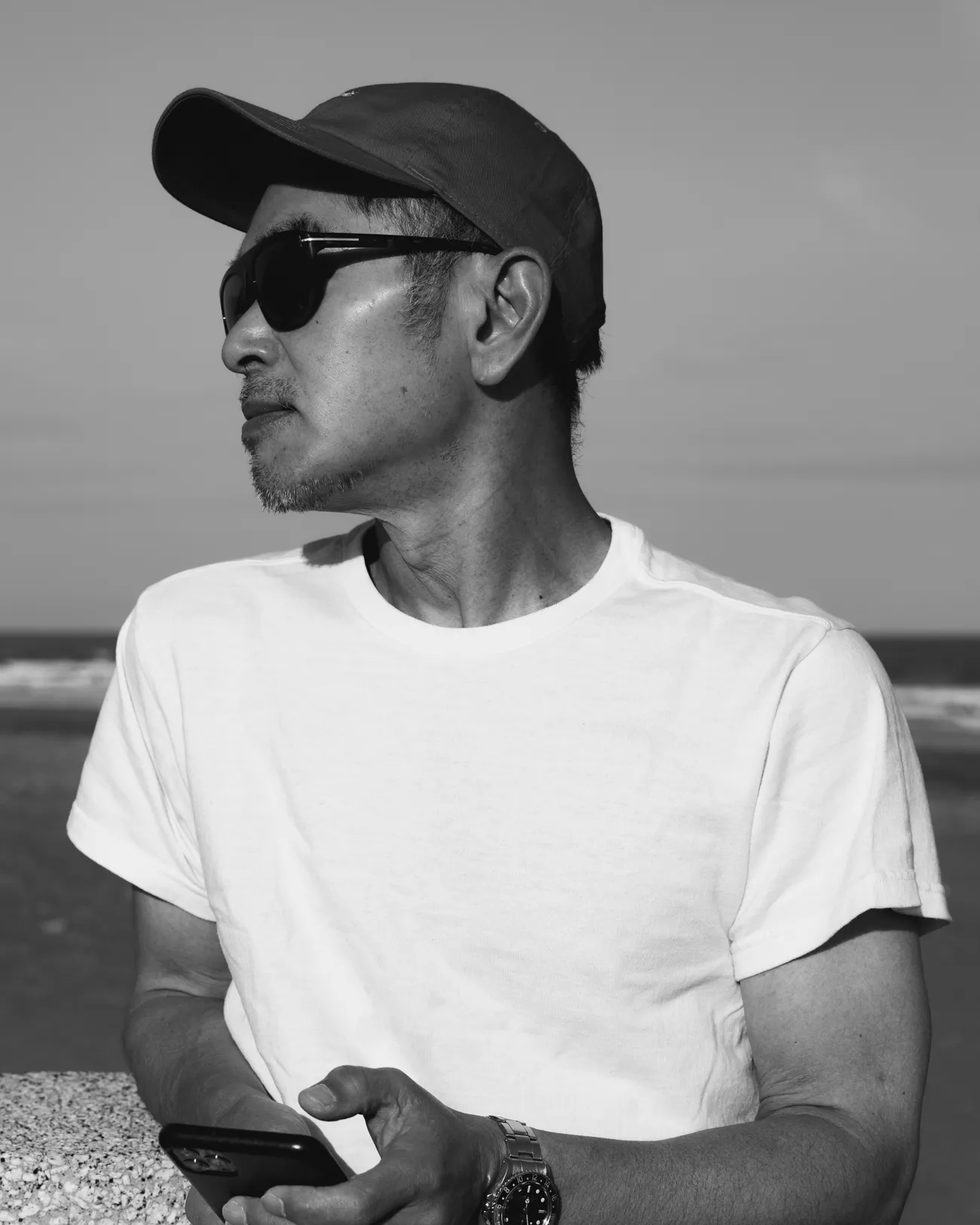
This article is a mobile-friendly adaptation of the piece I wrote for my sister site, Hooked-on: "Wasew Crew Neck T-Shirt." If the subject interests you, I encourage you to visit the original on Hooked-on as well.
Images on this site are formatted for mobile in a vertical layout, which can appear oversized on a desktop screen. If that bothers you, the Hooked-on version may be easier to read.
[ https://en.hooked-on01.com ]
This site, inter-est, rebuilds content from my WordPress site Hooked-on using Drupal — and uses Drupal's features to enable cross-referencing between articles and browsing by related content. My hope is that visitors find their curiosity — their interest — expanding as they move through the site.
In summer, when blue jeans dominate my wardrobe, I find myself reaching for a white T-shirt more than anything else. After searching for a genuinely good one — something that would stand up over time — I found what I was looking for in the Wasew crew neck T-shirt, made in Okayama. This article is about that T-shirt.
Wasew Crew Neck T-Shirt.
As the photographs below make clear, the starting point is the Hanes pack T-shirt. Over the past decade or so, one of the remarkable things about Japanese apparel has been the way makers take definitive American basics and, using contemporary Japanese manufacturing techniques, refine them into something that feels more like the original than the original itself — while correcting whatever weaknesses the original had.
Wasew is exactly that. The aim is to produce a T-shirt that, as it is worn and washed over time, ages in the way a Hanes pack T-shirt does when it is at its best. The thinking connects directly to Japanese denim — the idea behind raw denim that fades over time the way a vintage 501 does, developing the kind of character that makes the ageing worth following.
Coming back to the T-shirt: the Wasew has the silhouette of a Hanes pack T-shirt, with a subtle update to the proportions that reads as contemporary and flatters the body when worn. From new, through washing, it undergoes the same shrinkage and gentle distortion as the original Hanes — developing its own particular character as it ages.
1. Hanes.
The Hanes pack T-shirt is to T-shirts what the original 501 is to denim — a world unto itself. But it has one well-known weakness: the fabric is thin enough that it can show through. Wasew addresses this by using a slightly heavier fabric — a softly twisted cotton knit with a loose hand — so the result is a white T-shirt that does not show through, is comfortable to wear, and looks clean in a way the Hanes cannot always manage.
What makes Wasew impressive is that in solving that problem, the Hanes silhouette is left intact. The feel when you put it on — that relaxed American T-shirt quality — is unchanged. Worn with 501s, it produces a straightforward American style that comes together effortlessly and looks right.
※ The Schiesser Revival, covered in a separate article, is a different proposition — European in sensibility, with a longer sleeve, a tighter fit, and a slight tension in the overall look. The Wasew is a little looser, with shorter sleeves, and has that easy, unforced quality of American style. The two are worth having alongside each other; which to reach for depends on what you are wearing over it.
2. Okayama
I have loved crew neck T-shirts since childhood. In the years before imported Hanes and similar products were widely available in Japan, I wore domestic brands — Gunze, BVD — in both ways: as a top layer in the way we now think of T-shirts, and as an undergarment. By the time I was in high school, the early precursors to today's select shops were beginning to appear, and Hanes became accessible.
The Hanes crew neck T-shirt, like the Levi's 501, began as an everyday utility garment. But as a symbol of American culture — original and evolved forms alike — it has since become a fashion icon.
Made originally for mass consumption, it was the quality of its original function that gave it longevity — and that function eventually generated a different kind of value, of the sort that appears repeatedly in the history of clothing.
The Wasew crew neck T-shirt takes that icon and reinterprets it using Okayama's textile manufacturing capabilities — some of the most accomplished in the world.
3. A Brief History
A digression: in conversations about fashion with people a generation older than me, VAN always comes up. VAN was the brand that first presented modern menswear to young Japanese men in a coherent way — it brought a generation of men who had never thought about clothes to the point of caring about how they dressed.
At that time, the reference points were films and music magazines. The T-shirt, as a concept, did not exist in Japan — what you saw on American actors and musicians was technically underwear, and in Japan the only equivalent came in V-neck. So to approximate the crew neck look they had seen on screen, men would wear their V-neck undershirts inside out. I was told this by someone who lived through it, and I found it remarkable — a small, inventive act of improvisation.
The evolution of Japanese textile craft draws on deep roots — dyeing traditions, fabric manufacturing techniques developed over centuries. But there is another thread running through it: the willingness to look at something that does not exist in Japan and find a way to approximate it through original thinking. The inside-out V-neck story is a small example of exactly that impulse — and it is perhaps not too much of a stretch to suggest that this kind of inventive adaptation is part of what eventually produced the world-class textile manufacturing that Japan now has.
4. Going Global
The digression connects back: Wasew's approach to improving on the Hanes T-shirt is, in spirit, not so different from that inside-out V-neck story.
The thinking that goes into preventing show-through, or into engineering the way the fabric distorts with wear so that it ages in a particular way — I suspect this is a distinctly Japanese kind of attention. There is a parallel with vintage 501 fading: what began as unwanted deterioration was, in the process of forming a Japanese market around it, reframed as something valuable. The specific fading patterns — whiskers at the hips, honeycombs behind the knees — became desirable, and the industry responded by developing raw denim that would age that way naturally, or products pre-treated to simulate it. What began as a local Japanese phenomenon has since spread globally, which is genuinely fascinating.
5. A Universal Theme
Wearing blue jeans and a white T-shirt well is, in a sense, one of the perennial challenges of men's dressing — something most men have thought about at one point or another, whatever level of intention they bring to it. But it is not about dressing up; the fundamentals are the person wearing it. A lean physique, a natural tan — these things shape how the combination reads.
My own instinct, when I think about how I want to dress, is that the clothes should not come forward ahead of the person wearing them. They should look natural — effortless rather than studied.
6. Why I Rate It
What I value about the Wasew crew neck is this: from new through to the stage where it has been washed a few times and softened slightly, it consistently looks natural. Even as it ages, it never looks careless — the deterioration is calibrated well enough that it stays on the right side of the line. You can put it on without thinking about it and it looks like it belongs on you.
There is a particular pleasure in wearing something with genuine tension — a well-cut jacket, a structured piece that demands to be worn with intention. The Wasew crew neck is the opposite of that, and that is its value: it carries no tension at all. It is one of the few pieces I know that achieves that quality without sacrificing how it looks.
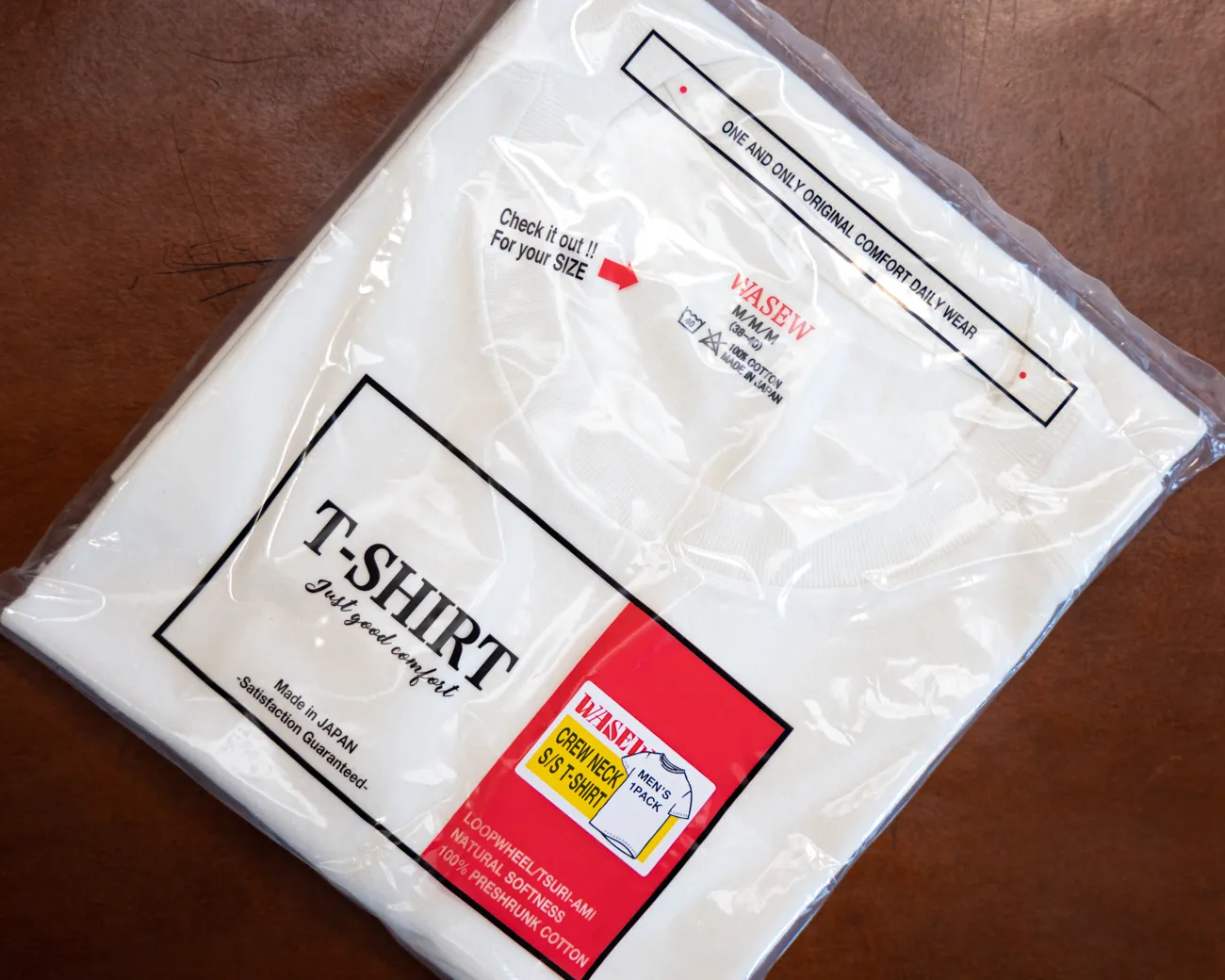
A playful nod to the Hanes pack T-shirt.
Styling.
A white T-shirt article calls for simplicity — worn here with blue jeans.
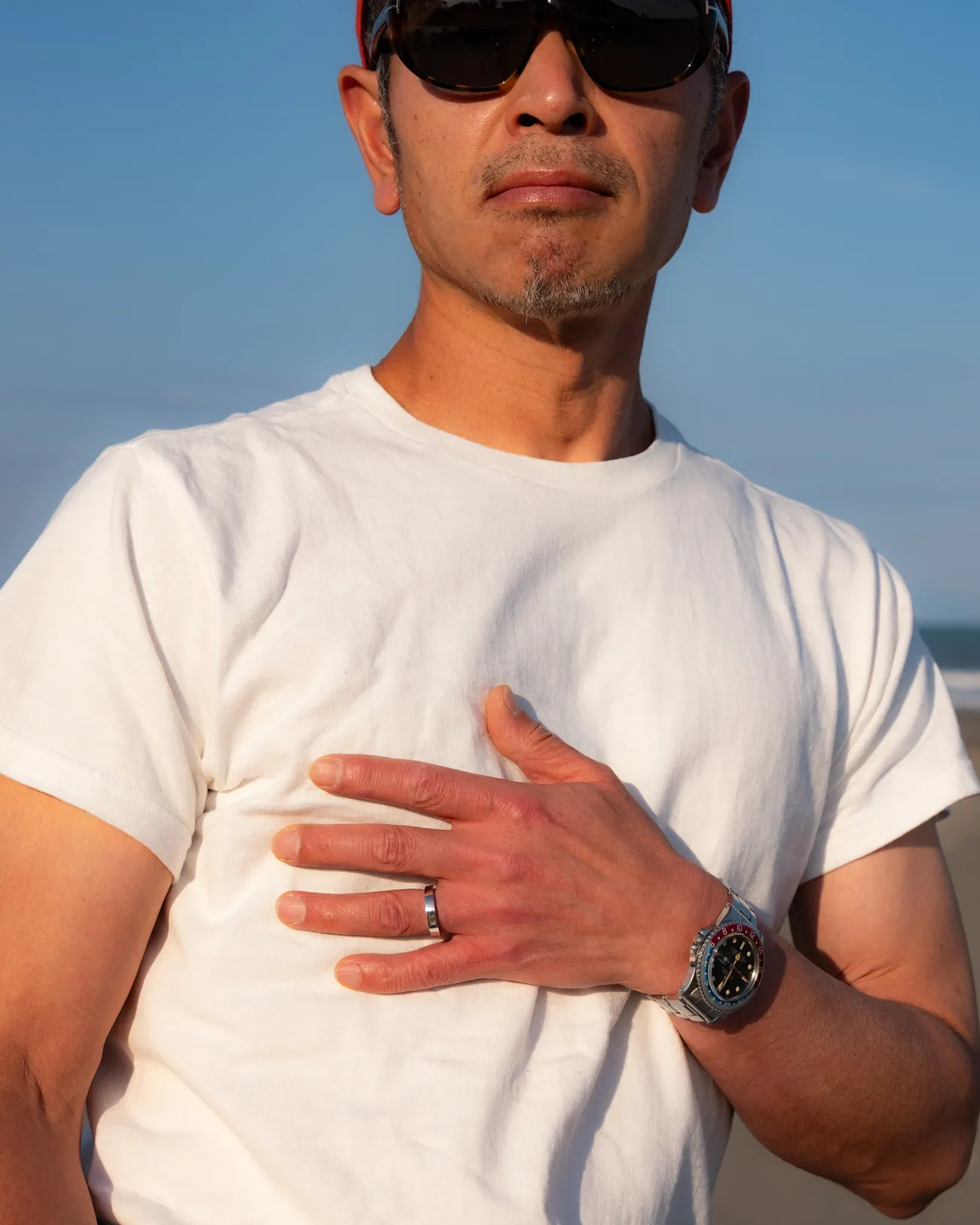
White works particularly well against tanned skin. A combination I come back to every summer without fail.
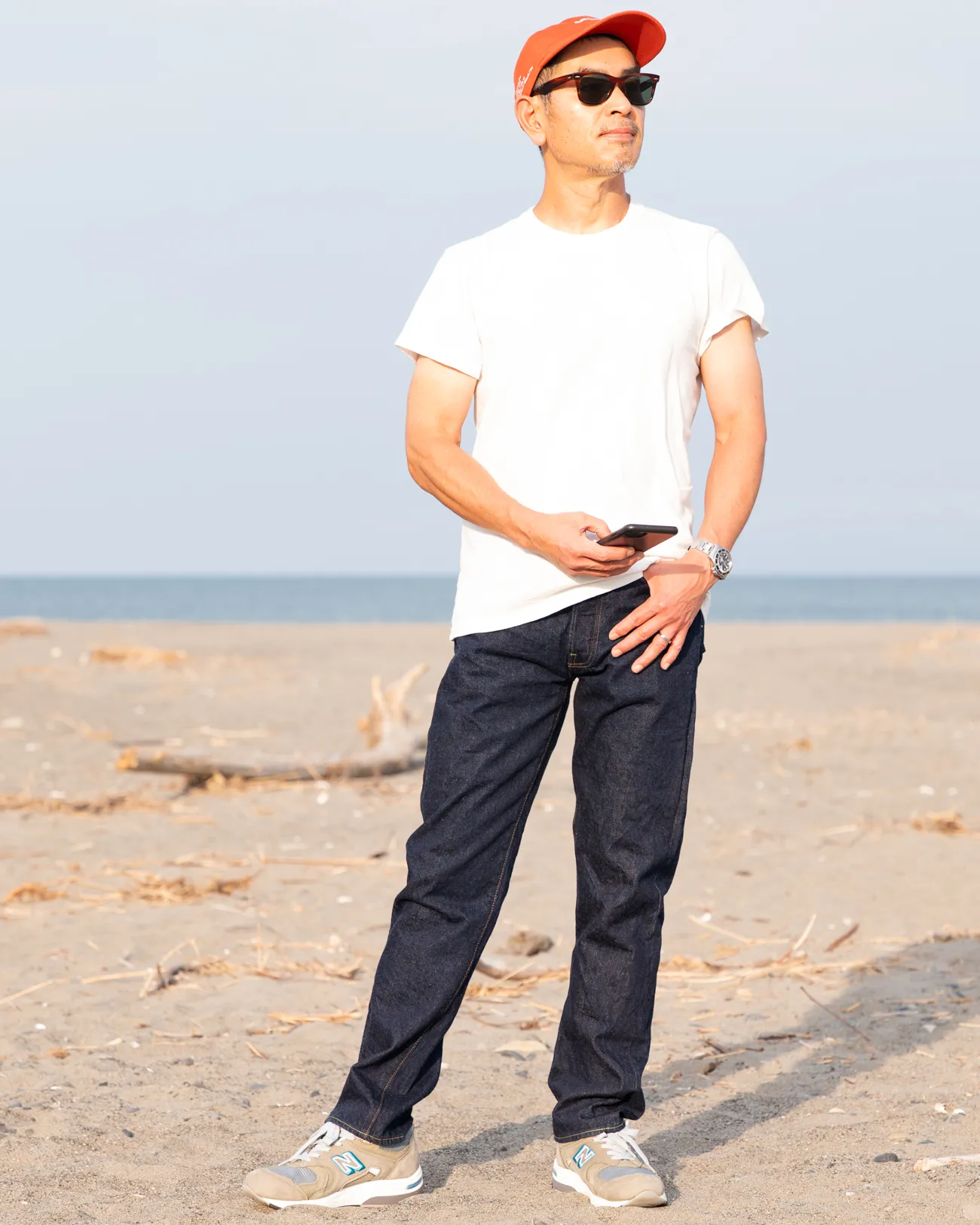
Pairing with a deep indigo raw denim adds a clean, sharp quality. Raw denim reads as fresh and unworn, which accounts for that impression. The clean silhouette of the Boncoura 66 — technically a one-wash, but essentially raw — works particularly well here. One note for summer: when perspiring heavily, raw denim can transfer dye onto a white T-shirt.
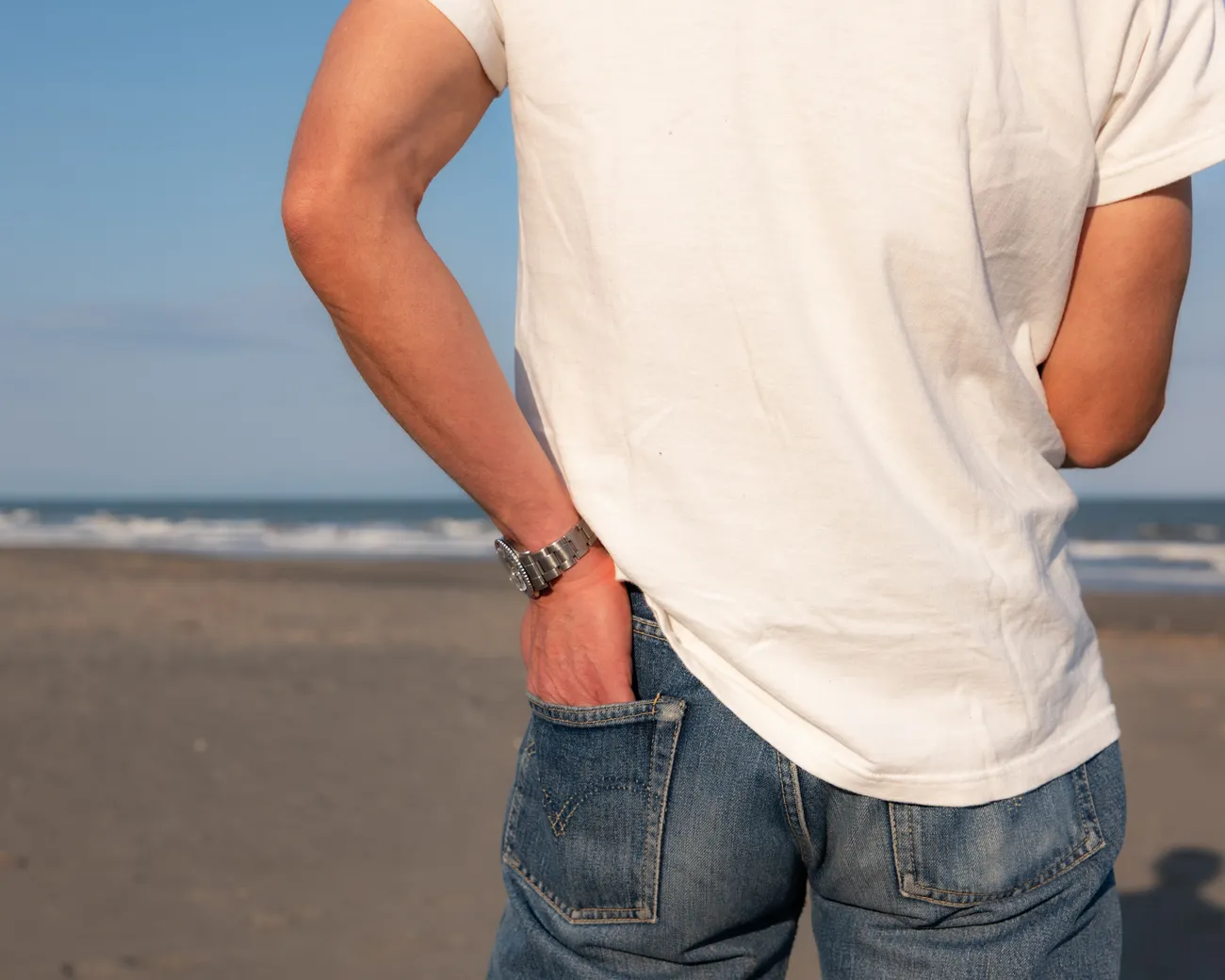
Paired here with a 1950s 501XX. An entirely orthodox combination — and arguably one of the definitive looks in men's dressing. I think of it as a kind of benchmark: if you can carry this off well, you can carry off almost anything.
Details.
- 100% cotton
- Regular fit — slightly relaxed through the body
- Fabric is soft and slightly heavier than standard — does not show through despite being white
- Standard crew neck opening
- Short sleeves; wide ribbed cuff with some ease
- Standard body length
Coordination.
- Crew neck T-shirt: Wasew, size M
- Denim: Levi's 501XX 55 Model
- Hat: Fresh Service
- Watch: Rolex GMT Master 1675 (1964)
- Sunglasses: Tom Ford
- Belt: White House Cox
Conclude.
Part of why I am drawn to American casual — jeans, military pieces, vintage clothing — is that it allows for effort without looking like effort. A style that does not try too hard, that carries a certain ease. I imagine I am not alone in that.
For summer dressing, the Wasew crew neck takes the definitive American T-shirt form, corrects its one real weakness, and makes it a pleasure to wear. Soft, comfortable, and easy — it has become a summer staple. It works as well with shorts and military trousers and chinos as it does with jeans, which means one T-shirt covers a great deal of ground.
Purchasing Store.
The Wasew crew neck T-shirt introduced here was purchased at Post78.
Post78 is run by an owner with a genuine passion for clothing, and carries a carefully chosen selection of quality pieces built to last. I shop there regularly — and the conversations about fashion with the owner are always part of the pleasure of going.