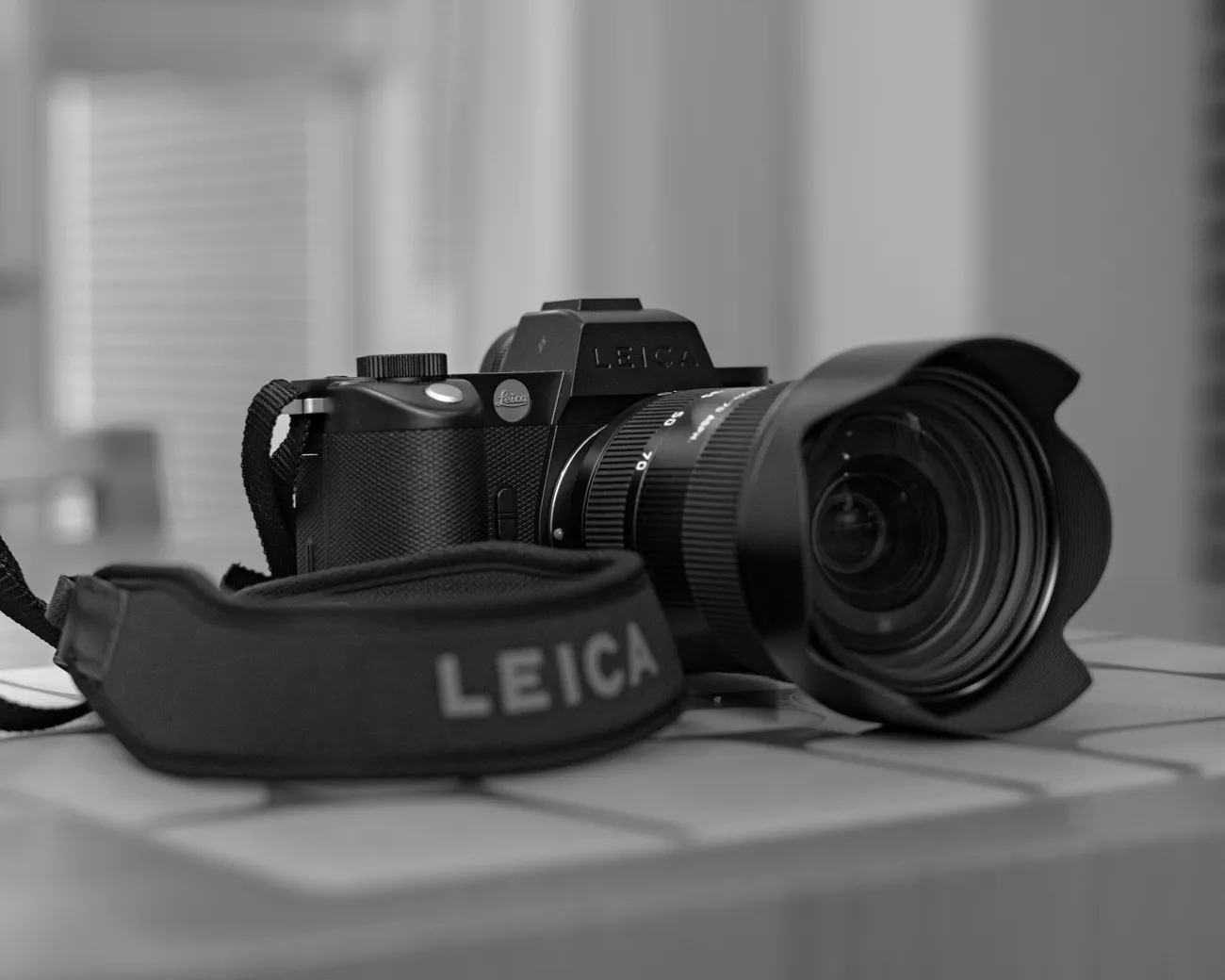
This article is a mobile-friendly adaptation of the piece I wrote for my sister site, Hooked-on: "Leica SL2-S." If the subject interests you, I encourage you to visit the original on Hooked-on as well.
Images on this site are formatted for mobile in a vertical layout, which can appear oversized on a desktop screen. If that bothers you, the Hooked-on version may be easier to read.
[ https://en.hooked-on01.com ]
This site, inter-est, rebuilds content from my WordPress site Hooked-on using Drupal — and uses Drupal's features to enable cross-referencing between articles and browsing by related content. My hope is that visitors find their curiosity — their interest — expanding as they move through the site.
All photographs on this site are taken with the Leica SL2-S.
When I decided to build this site and began thinking seriously about photography, I spent a good deal of time considering which camera to use. In the end, I wanted to stay with Leica — the system I know best. Having used only M-series cameras until then, I made the leap to the SL2-S, Leica's mirrorless system camera.
I considered the higher-resolution SL2 as well, but for my purposes the SL2-S with its more manageable pixel count has proved exactly right. Both the SL2 and SL2-S happened to be running a campaign at the time, at a considerable discount. What I purchased was the Leica SL2-S with Vario-ELMARIT-SL f2.8/24-70 ASPH. kit.
Leica Ginza Store.
I bought it at the Leica Ginza store, working through the decision with one of their most experienced staff members. He is a veteran who has spent many years introducing customers to Leica at the Ginza store, and someone I have known for a long time.
He came originally from a lab background — he spent years overseeing professional-grade final prints — so his understanding covers the entire process from the moment of capture through to the finished image. When I explained what I was doing, he was clear: for this application, the SL2-S suits you better than the SL2 — and he explained exactly why in terms I could follow.
Why I Chose It
The two deciding factors for the SL2-S were its high-ISO performance and its manageable file size. Coming from someone who had spent years watching how professional prints were made, the conversation went deep: how much cropping latitude do you need, what does that margin cost you in file management, how much does it add to your post-processing workload — all of that was laid out clearly. His thinking was more professional than mine; I had assumed that more megapixels would always be better, and he redirected me toward the right answer.
On the lens side, he made a similarly practical point: rather than committing to a prime straight away, it makes more sense to shoot for a while and see which focal lengths feel right. The standard zoom is capable enough — the telephoto end delivers genuinely good image quality, and at the wide end, for anything other than close-up work, it performs without reservation. Compared to a Leica prime it shows its limits, but assessed on its own terms it is an excellent lens.
Impressions After Using It
After living with the camera for some time, I am certain the choice was right. I have no dissatisfaction with how I work with it, and the image quality is unmistakably Leica. It lacks the particular pleasure of shooting with an M-series — that sense of craft and deliberateness — but what the SL series offers in return is the ability to photograph anything. That versatility is the SL's greatest strength.
The SL2-S is approaching the end of its production cycle, and a successor will come in time — the SL3 has since followed — but the quality I can achieve with this camera remains entirely sufficient, and it has been an extremely satisfying purchase. (This article was written in early 2023; as of 2024, the SL series has passed the baton to the SL3.)
The SL2-S with the Vario-ELMARIT-SL f2.8/24-70 ASPH. is also what makes the self-portraits on this site possible. For those shots I use a Gitzo carbon tripod and tether to an iPhone via the Leica FOTOS app for remote release.
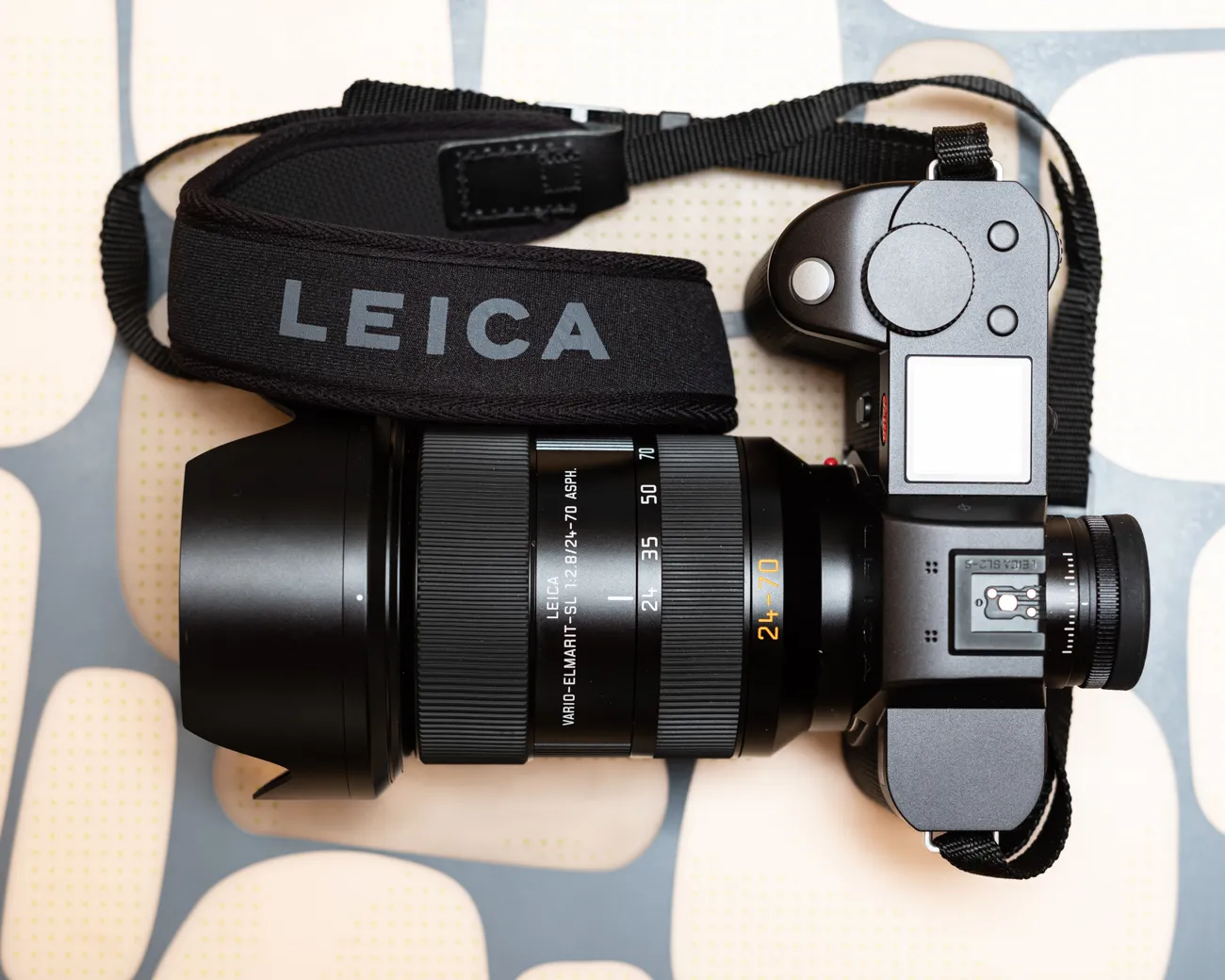
The Leica SL2-S with Vario-ELMARIT-SL f2.8/24-70 ASPH.
Images Shot with the Leica SL2-S
※ The original Hooked-on article processes photographs in the 2:3 aspect ratio of the 35mm format. This site processes images in the 4:5 aspect ratio of the large-format tradition.
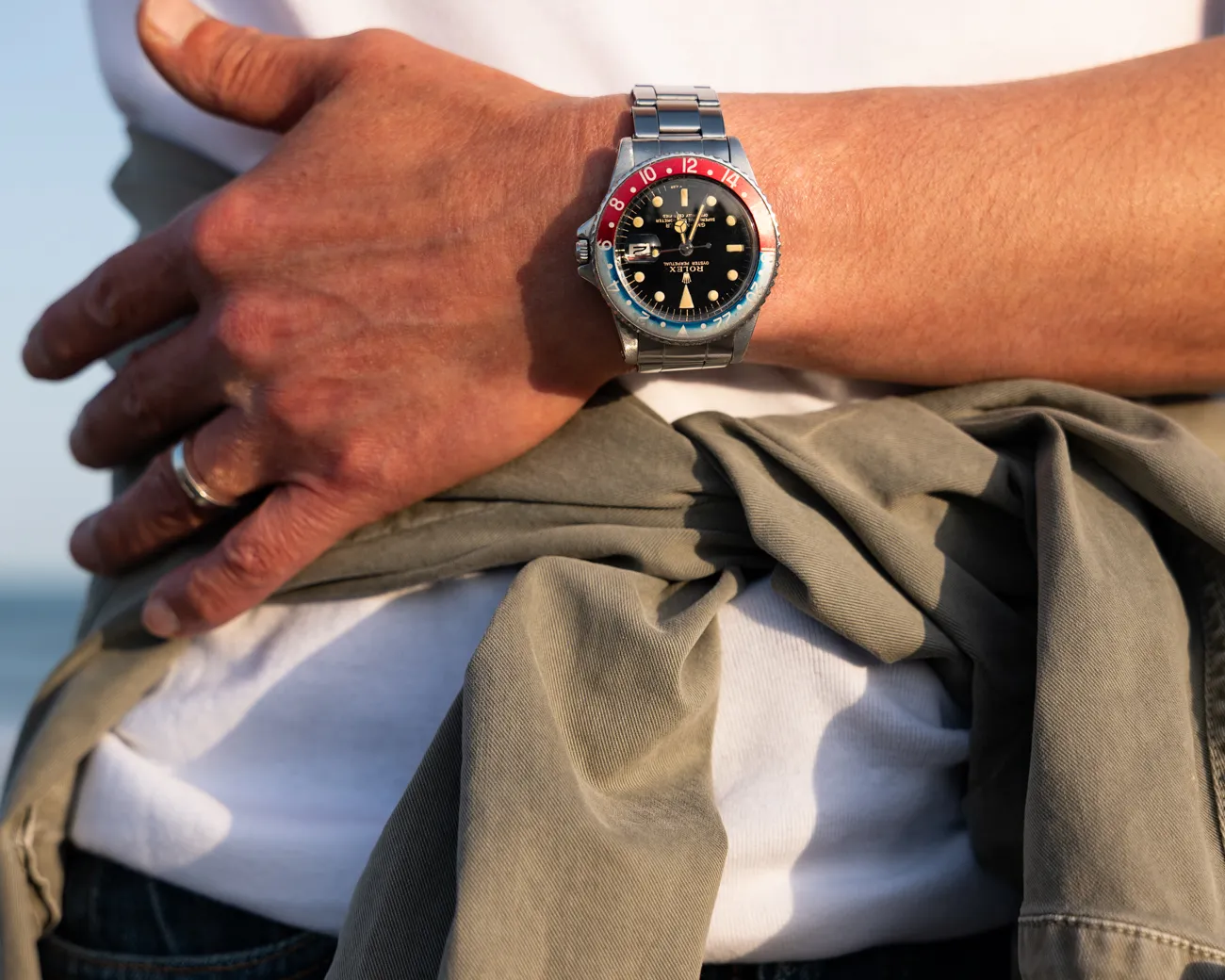
Focus is on the text of the GMT Master dial, but the characteristic Leica sharpness comes through clearly. The rich tonal gradation means that despite the moderate pixel count the files are light and the latitude for post-processing is generous — which is precisely why the SL2-S is chosen for professional work.

Shot with a macro lens; the shallow depth of field requires stopping down, which is where the high-ISO performance earns its keep. Focus is on the red segment of the bezel and the hour hand. Leica's digital cameras degrade at high ISO in a way that reads as distinctly film-like — a quality born of the long history of understanding how light behaves.

The strong file latitude makes it straightforward to crop, adjust contrast, and convert to a monochrome with an antique treatment. Monochrome images derived from SL2-S colour files are not simply desaturated — they read as genuine black-and-white photographs.
I also use the first-generation Leica M Monochrome. Nearly fifteen years on, the Kodak-developed sensor remains strikingly film-like in character — the way the image shifts with light and ISO closely resembles the behaviour of Tri-X. There is no other camera quite like it, and I cannot part with it. The ability to create value that runs counter to the assumption that the latest digital is always best is, I think, one of the things that defines Leica.
It is the consistent inheritance of Leica's photographic philosophy that is the deepest reason I work with the SL2-S.
Conclude.
Built to professional standards, it performs at a high level across every stage — capture, post-processing, and final output. It is also an excellent choice for anyone who wants to use Leica's historic lens heritage on a modern digital body.
As the technical data below confirms, operating temperature, dust and splash resistance, sensor and image engine performance, high-ISO capability, autofocus range and tracking, exposure control, and flash control are all specified to professional standards. This is a full-frame mirrorless system camera capable of photographing anything.
Details.
Leica Camera / Leica SL2-S — Technical Data — photography specifications extracted below. ※ Video capabilities are also excellent, though I do not use them.
Camera Body
- Type 35mm full-frame sensor mirrorless system camera
- Buffer memory 4GB (DNG™: 999+ frames, JPEG: 999+ frames)
- Recording media SD / SDHC / SDXC memory cards (UHS-I compatible; UHS-II recommended)
- Materials Body: full-metal aluminium and magnesium construction; Exterior: synthetic leather covering; Dustproof and splashproof (IP54 per IEC 60529)
- Lens mount Leica L bayonet mount with electronic contacts for camera-to-lens data communication
- Operating temperature -10 to +40°C
- Dimensions (W × H × D) 146 × 107 × 83 mm
- Weight approx. 840g (without battery) / approx. 920g (with battery)
Image Sensor
- Sensor CMOS; pixel pitch 5.94μm; 24.6MP full-frame (6072 × 4056px), 10.6MP APS-C (3984 × 2656px)
- Image stabilisation 5-axis in-body optical stabilisation; 5.5 stops correction
- Filter RGB colour filter; UV/IR filter; no low-pass filter
- Image processor LEICA MAESTRO III
- Recording format Still: DNG™ (RAW), DNG™ + JPEG, JPEG (DCF / Exif 2.31)
- Video: MP4 (H.264/MPEG-4 AVC, 2ch 48kHz/16bit AAC), MOV (H.264/MPEG-4 AVC, 2ch 48kHz/16bit LPCM)
- Resolution Full-frame: DNG™ 6000 × 4000px (24MP); JPEG 6000 × 4000 (24MP) / 4272 × 2848 (12.2MP) / 2976 × 1984 (5.9MP)
APS-C: DNG™ 3963 × 2624px (10.3MP); JPEG 3963 × 2624 (10.3MP) / 2736 × 1824 (5MP) / 1920 × 1280 (2.5MP) - Colour depth DNG™: 14-bit; 12-bit in ultra-high-speed burst (25fps); JPEG: 8-bit
- Colour space Still: sRGB; Video: Rec.709, Rec.2020 (HLG), L-Log
- File size DNG™: approx. 44MB; JPEG: varies by resolution and subject
Viewfinder / Display
- Electronic viewfinder 5.76M dots; 120fps display rate; 0.78× magnification; 4:3 aspect ratio; 100% field of view; 21mm eye relief; dioptre adjustment -4 to +2dpt; eye sensor with auto EVF/LCD switching; display lag 0.005s
- LCD monitor Touchscreen; 3.2-inch; 3:2 aspect ratio; 2.1M dots; LED backlight; scratch- and fingerprint-resistant coating
- Top display High-reflectance transflective monochrome LCD; 1.28-inch; 128 × 128 dots; 120° viewing angle; fingerprint-resistant coating
Shutter
- Type Electronically controlled focal-plane shutter; electronic shutter
- Shutter speed Mechanical: 30 min (bulb) to 1/8000s; Electronic: 60s to 1/16000s; Flash sync: 1/250s
- Shutter button Two-stage: half-press activates electronic functions (AF, metering); full press releases shutter
- Self-timer 2s or 12s
- Continuous shooting Low 2fps; medium 5fps; high 9fps (AFc, AE lock, white balance off); ultra-high 25fps (electronic shutter, AFc, AE lock, white balance off); interval shooting; auto bracketing
- Multi-shot 96MP (8 frames composited into a single high-resolution image)
Focus
- Focus mode Autofocus (intelligent AF, AFs, AFc, touch AF); manual focus with focus aid and focus peaking
- Detection Contrast detection and depth map
- AF mode Intelligent AF (auto switching between AFs and AFc); AFs (single, focus priority); AFc (continuous, release priority); AF settings can be saved
- AF area Spot (repositionable); single-point (repositionable); multi-point; zone (repositionable); face detection; tracking AF; touch AF
- AF points 225
Exposure
- Metering TTL metering
- Metering modes Centre-weighted; multi-zone; spot
Exposure modes Program AE (P); Aperture priority AE (A); Shutter priority AE (S); Manual (M) - Exposure compensation ±3EV in 1/3EV or 1/2EV steps
- Auto bracketing Up to ±3EV; 1/3EV steps; 3 or 5 frames
- ISO Auto: ISO 100–100000; Manual: ISO 50–100000
- White balance Auto; Daylight/5200K; Cloudy/6000K; Shade/7000K; Tungsten/3200K; HMI/5600K; Fluorescent warm/4000K; Fluorescent cool/4500K; Flash/5400K; Grey card live view; Manual; Colour temperature (2000–11500K)
Flash
- Flash connection Accessory shoe
- Flash sync speed 1/250s; slower speeds also supported; faster speeds automatically switch to high-speed sync (with compatible Leica flash units)
- Flash control TTL centre-weighted with pre-flash (with Leica SF26, SF40, SF58, SF60, SF64, compatible third-party units, Leica SF C1)
- Flash exposure compensation ±2EV in 1/2EV steps (with Leica SF 40)
±2EV in 1/3EV steps (with Leica SF 60)
Other Features
- Microphone Built-in stereo; external mic input (3.5mm stereo jack, plug-in power approx. 2.5V)
- Speaker Built-in mono; headphone output (3.5mm stereo jack)
- Wi-Fi Requires Leica FOTOS app (available from Apple App Store™ and Google Play Store™); IEEE 802.11b/g/n (2.4GHz, ch 1–11 / 2412–2462MHz), IEEE 802.11ac (2.4GHz and 5GHz); WPA™/WPA2™ encryption
- Bluetooth Bluetooth 4.2 (BLE); 2402–2480MHz
- GPS Via Leica FOTOS app
- Display languages English, German, French, Italian, Spanish, Russian, Japanese, Simplified Chinese, Traditional Chinese, Korean
Power
- Battery Rechargeable lithium-ion (BP-SCL4); rated DC 7.2V, 1860mAh; charge time approx. 140 min from fully discharged
- Shot count Approx. 510 shots (CIPA standard, auto power-off at 10s); approx. 1430 shots (CIPA standard, fixed cycle*, auto power-off at 5s)
* Cycle: power on → 1 shot every 3s → power off after 10 shots → 5 min standby → power on → 1 shot every 3s → power off after 50 shots → 5 min standby - USB charging / power supply USB charging in standby and when powered off; USB power supply when powered on
- Battery charger (BC-SCL4) Input: AC 100–240V (50/60Hz, auto-switching), 0.25A; Output: DC 8.4V, 0.85A
Purchasing Store.
The Leica SL2-S with Vario-ELMARIT-SL f2.8/24-70 ASPH. kit was purchased at the Leica Ginza store.
Japan's first Leica flagship store, staffed by people who know Leica thoroughly — they will talk through your options and help you arrive at the right choice with confidence. The particular pleasure of shooting with an M-series, the distinctive rendering of M-series lenses, and the versatility of the SL series — all of it, and the unmistakably Leica quality that comes through in every image.