Through the previous article , I audited Drupal 11, adjusted its settings, and switched to an independent theme. This article records a fresh Drupal 12 beta installation and its behavior, with the Drupal 11 environment retained as a baseline.
After reviewing the Drupal 11 production environment, I installed Drupal 12.0.0-beta2 in a separate DDEV project.
The aim was to understand what changes in the next version and how much of my production workflow and independent theme could carry over, rather than immediately upgrade the existing site.
The initial tests took place on November 1, 2026. On November 2, I migrated the real articles from Drupal 11 and continued comparing rendering and design. This article distinguishes the initial tests using synthetic content from the subsequent checks using real articles.
The beta is not intended for production use. I did not operate it as a publicly accessible CMS. Official Drupal 12.0.0-beta2 release information ↗
Keep the baseline and test environments separate
| Item | Baseline | Fresh test environment |
|---|---|---|
| Drupal | 11.4.11 | 12.0.0-beta2 |
| PHP | 8.4.27 | 8.5.12 |
| MariaDB | 10.11.19 | 10.11.19 |
| Theme | Independent custom theme | The same theme source |
| Initial content | Existing articles | Synthetic articles and information pages |
| Subsequent checks | Retained as the baseline | Copied published content and its Japanese and English bodies for display comparisons |
Drupal 12 requires PHP 8.5. I prepared this environment after checking the official requirements. Drupal 12 platform requirements ↗
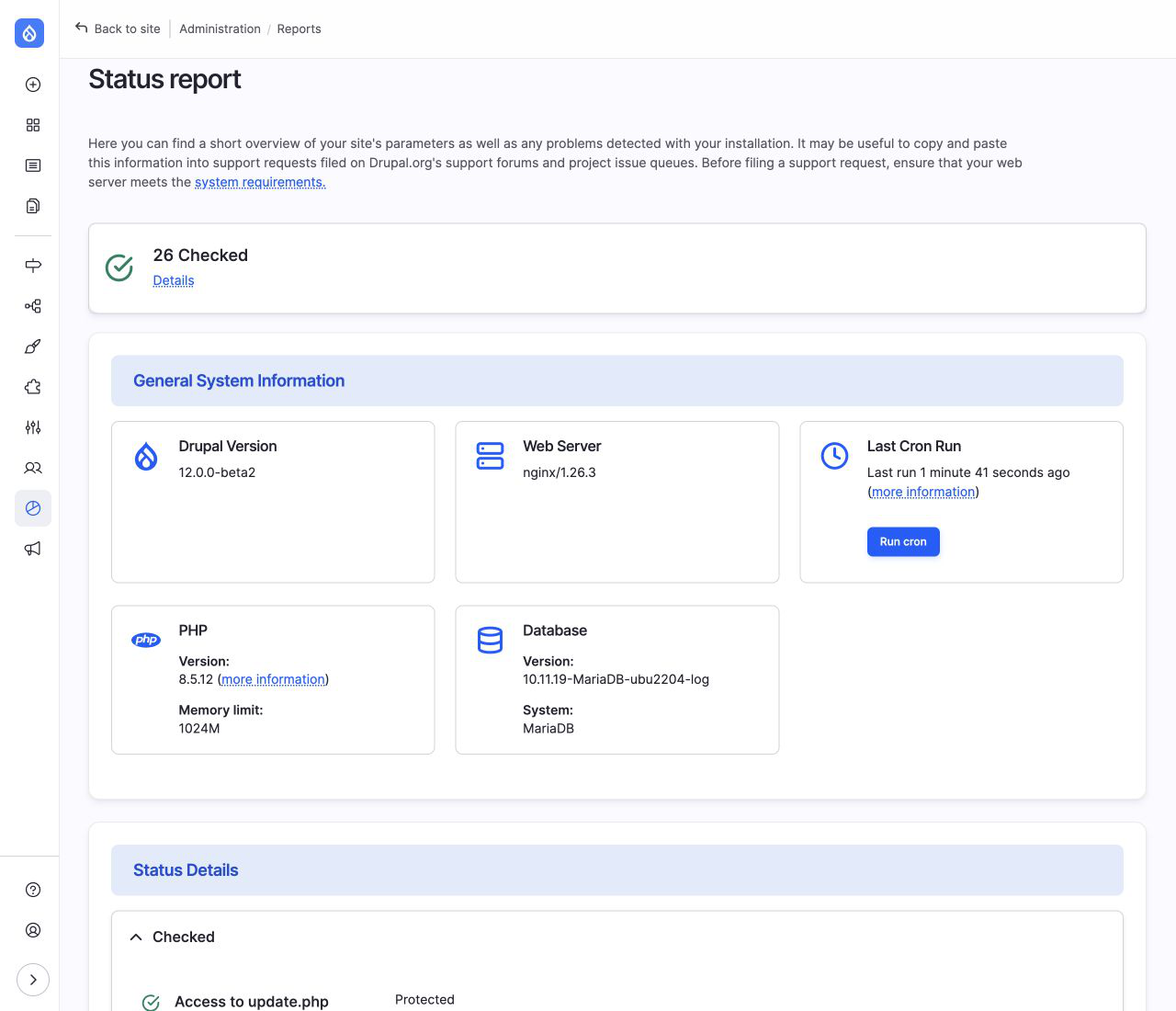
*The English-language Drupal 12 status report, captured on November 2, 2026. Drupal 12.0.0-beta2 and PHP 8.5.12 are visible as recorded when the screenshot was taken. Select the image to open it at full size. *
Bringing in the existing database immediately would make it harder to distinguish fresh-installation issues from those caused by existing configuration, contributed modules, or data. For the first stage, I therefore used synthetic content: four articles, three information pages, and one dedicated home page, without copying the database or real articles.
Synthetic content consists of temporary articles prepared for display checks. I first checked that content could be saved and displayed, that the theme loaded, and that navigation worked. Handling existing articles, images, and translations was tested separately.
This is therefore not a successful database upgrade from Drupal 11. It records a fresh Drupal 12 installation and initial tests of an independent theme.
The first obstacle was Drush’s dependencies
After placing the Drupal packages, I tried to add Drush through Composer. The stable releases considered under the conditions of that attempt conflicted with Drupal 12’s library requirements.
The output identified dependency conflicts involving Drush candidates up to 13.8.0 and the Guzzle 8 and Symfony 8 libraries on the Drupal 12 side. Installation failed, and Composer restored the configuration and lock file.
When packages require mutually exclusive versions of the same library, Composer cannot produce a configuration that satisfies them together. This failure occurred during dependency resolution while adding Drush, rather than while opening a Drupal page.
I did not override the compatibility constraints. Instead, I built the site using Drupal core’s installation API. That uses Drupal’s own installation process; it does not mean Drush was successfully installed. I recorded Drush availability separately from Drupal’s ability to start.
This result does not establish that every Drush version is incompatible with Drupal 12. It records the conditions tested, rather than a general conclusion covering development versions or future releases.
Follow-up: allowing dependency updates (November 2, 2026)
After the initial attempt, I wondered whether allowing related packages to update together would make Drush installable. I first ran ddev composer require drush/drush, but it failed because of dependency conflicts, including Drush’s requirement for Guzzle 7 versus the installed Guzzle 8.2.0.
I then limited the candidate to Drush 13.8 and allowed related dependencies to change, using a dry run that would not install packages:
ddev composer require 'drush/drush:^13.8' -W --dry-run
The -W option allows related dependencies to be considered for changes, while --dry-run checks dependency resolution without installing packages. These options do not bypass compatibility requirements. Composer’s official require command documentation
This attempt also failed to find an installable configuration. The output reported that the Guzzle 7 candidates required by Drush 13.8.0 were excluded because they were affected by security advisories. Composer reported restoring composer.json and composer.lock afterward. I did not disable security blocking to proceed.
Drush 13.8.0’s dependency definitions also require Guzzle ^7.0 and versions 6 or 7 of several Symfony components. These requirements do not overlap with Drupal 12’s Guzzle 8 and Symfony 8 requirements, so changing the update order alone cannot resolve the conflict. Drush 13.8.0 dependency definitions
These checks identified the obstacle as the compatibility requirements of the Drush candidate and Drupal 12 at the time of testing, rather than a Mac or DDEV configuration issue. Alongside checking that Drupal itself runs, confirming support for everyday tools used to clear caches and update the database is an important part of deciding when to migrate. I plan to check for a Drupal 12-compatible Drush release and repeat the test in the same environment.
Verify the available structure while building a new environment
For content types and body fields, I also checked the installed configuration and available plugins rather than assuming that the Drupal 11 structure was already present.
Early setup scripts assumed content types or field plugins that did not exist, causing errors during rendering and configuration creation. I corrected those assumptions in the setup code.
A content type defines the fields an article or information page has. Even if a body field exists, its presentation may differ from expectations when the display configuration or HTML text format is unsuitable.
For this sample, I explicitly configured article and page types, Long text body fields, HTML formats, and display settings. Errors encountered while building the setup should not automatically be treated as Drupal core defects.
The first audit matched a known advisory
After the fresh installation, I audited 67 Composer-managed packages. At that point, symfony/mime 8.1.7 matched CVE-2026-45070.
Symfony’s official advisory describes insufficient validation of MIME header parameter names. I did not demonstrate an attack or exploitation here; the installed package version matched a published advisory. Official Symfony advisory
Checking the Drupal version alone does not reveal the library versions actually installed alongside it. As in Part 1, I needed to examine the core version and dependency audit separately.
I saved the initial audit, kept Drupal at 12.0.0-beta2, and updated libraries within the allowed Composer dependency constraints. Keeping the before and after results makes it possible to see which configuration matched the advisory and which changes removed the match.
| Package | Before | After |
|---|---|---|
| symfony/mime | 8.1.7 | 8.1.10 |
| symfony/polyfill-mbstring | 1.43.0 | 1.43.3 |
symfony/polyfill-mbstring was a related package updated at the same time. The table does not mean that both packages matched the same advisory.
After the update, the lock-file audit found zero known vulnerability advisory matches. PHP and extension requirement checks also passed. These results apply to this configuration and the information checked at that time, not to all custom code, the entire operating system, or every possible use of the site.
Neither the beta label nor the core version tells the whole story. This was a reason to inspect the actual dependency composition after installation.
Install the same independent theme
I placed the independent theme built for Drupal 11 in the test environment as well. It has neither Stable 9 nor Bootstrap5 as a base theme.
Initially, I checked the home page, article bodies, navigation, switching between Japanese and English URLs, and basic rendering at mobile widths. Japanese pages used the theme’s Japanese interface text, but the synthetic article bodies did not have Japanese translations at this stage. Displaying a language switch and handling real bilingual articles are separate checks.
Taking the Drupal 11 configuration YAML finding into account, I placed the synchronization directory outside the public document root in the test environment. I also applied settings-file protection and Nginx access restrictions, then checked the state after restarting DDEV.
Move on to real Japanese and English articles
After the basic rendering checks, I migrated Drupal 11’s published articles to Drupal 12 on November 2. Using the same content made it possible to check long bodies, photographs, classifications, translations, and links between articles that synthetic content alone had not covered.
I backed up the database and theme before this stage too. I then replaced the synthetic content and copied 59 published items of the article content type. This includes About; there are 58 regular articles. Across Japanese and English, that makes 118 bodies.
The transferred data included titles, bodies, summaries, image fields, classifications, tags, shops, article numbers, dates, and URLs. I did not bring over user accounts, passwords, unpublished articles, or the full revision history. Public author names were retained as strings for display.
Again, this is not a database upgrade to Drupal 12. It is a test of transferring the required public content into the structure of a fresh Drupal 12 installation.
Preserve bodies and summaries in the available fields
The real-content migration also stopped where it assumed the old environment’s structure. The text_with_summary and text_summary_or_trimmed plugins used by the source articles were not present in this Drupal 12 environment.
I changed the setup to use a Long text (text_long) field for the body and a separate summary field, and adjusted the theme to read that summary. I did not copy the old plugin files into Drupal core or ignore their operating requirements.
Matching the field structure was not enough: preserving the original bodies and summaries mattered. I extracted and compared the values after migration. All 118 body SHA-256 hashes matched, and all 118 summaries matched too. I treated visual changes separately from verifying that the saved data was the same.
Check images, URLs, and article order
The main post-migration results were as follows.
| Check | Result |
|---|---|
| Published content of the article type | 59 items; 118 Japanese and English bodies |
| Saved bodies and summaries | All 118 matched the source data |
| Target field values | 1,062 matched |
| URL aliases | 176 matched |
| Classification | Four vocabularies and 29 terms migrated |
| Anonymous HTTP requests to article, classification, and bilingual home pages | 200 for 178 pages |
| Image URLs collected from rendered HTML | 200 for 119 URLs |
I checked image references inside article bodies and copied existing generated images and the required originals. I did not verify that every image style from the source environment could be regenerated under identical conditions. The checks established HTTP availability and actual rendering in representative articles.
At first, the article order differed from Drupal 11. Investigation showed mismatches in creation timestamps on the added translations and in the language conditions of lists. I restored each source translation’s creation time and sticky status, and adjusted the list conditions.
The home pages now show four articles per section, matching Drupal 11. I compared link order in 114 lists identified by URL, including Japanese and English home pages, classifications, and tags, and confirmed a match. That count includes both numeric URLs and aliases. I combined Drupal 11’s subsequent list pages when comparing order; this does not mean both sites have the same pagination boundaries.
Use color to distinguish the environments
I retained the Drupal 11 layout as the basis but changed Drupal 12’s dark green to navy and the orange accent to a muted blue. I then changed the background to pure white, #FFFFFF. This makes it possible to compare how color changes the impression of the same articles in a similar layout.
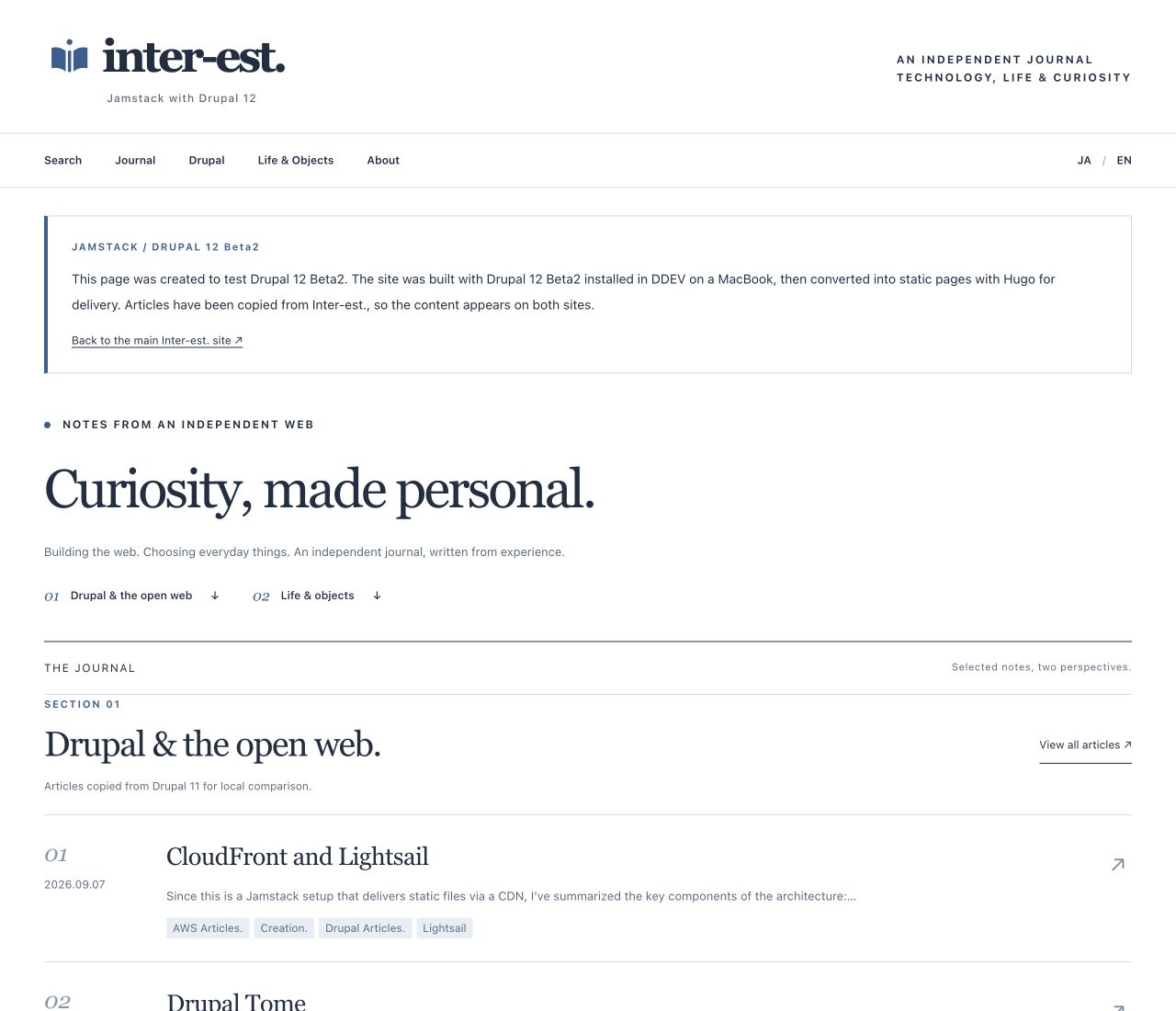
A preview of Drupal 12’s presentation output through Hugo. It uses white, navy, and blue in contrast with Drupal 11’s warm palette. The screenshot shows the English page.
I checked the desktop three-column display, representative articles at 390px, table-of-contents generation, related articles, previous/next navigation, and language switching. Body and summary fields also appear in the editing screen, but that does not mean a complete edit-and-save workflow has been tested. The logged-in administration toolbar also overflows horizontally at 390px; I am retaining that as an issue separate from the theme area.
The presentation is available in the Jamstack with Drupal 12 static sample . It consists of anonymous-view HTML obtained from local Drupal and output as static files through Hugo. The public delivery server does not run the beta CMS, and the sample provides no login or publishing functions. It can be compared with the Drupal 11 sample .
Record the scope and continue testing
The initial checks on November 1 covered a fresh installation, basic theme rendering with synthetic content, main-page HTTP responses, dependency audits, and basic protection of settings files. On November 2, I transferred the published Japanese and English article bodies, images, classifications, and URLs, then compared saved values and representative screens.
I did not transfer Drupal 11’s contributed-module configuration unchanged. Compatible releases and behavior for Metatag, Token, and Tome, along with comments, fine-grained permissions, editing and saving, and image regeneration, require individual checks. Hugo produced the static samples; that does not establish Tome’s Drupal 12 compatibility.
The PHP versions also differ between these two environments. A difference in behavior alone cannot be attributed to Drupal core. Where needed, further tests with the same PHP version would help isolate the cause.
A personal local environment lets me try things, restore them, compare results, and record the process. I want to leave a useful record for the next person testing a similar setup, including both what worked and where my assumptions needed correction.
Follow-up: official-source comparison (November 4, 2026)
These notes were added after reviewing official sources on November 4. They are separate from the November 1–2 measurements; no Drupal environment was changed or retested.
The default content-type change starts with 11.4
The official change record ↗ dates removal of Article/Page defaults from Standard profiles/recipes to 11.4.0, rather than Drupal 12 beta alone. Differences between an established Drupal 11 site and a fresh Drupal 12 installation are not all major-version changes. See the related guide annotation .
Text with summary can also continue through a contributed module
The change record ↗ describes moving text-with-summary plugins into a deprecated module in 11.5 and removing that module from core in 12. The Text With Summary contributed project ↗ documents continuation and migration.
Using text_long and a separate summary field was this experiment’s choice, not a mandatory conversion for every existing site. Before upgrading an existing site, review the provider, field configuration and stored data. Neither the contributed-module route nor an existing-database upgrade was tested here.
New documentation does not replace historical dependency results
The official DDEV setup reference ↗ includes adding Drush. That does not establish that the documented Drush 13.8.0 / Drupal 12.0.0-beta2 dependency conflict has been resolved. The failure logs, dry-run, 67-package audit and 118-body comparison remain records of their stated conditions. No Drush reinstall or additional edit/save experiment was performed in this follow-up. See the Local Development annotations .
Follow-up: core CLI alternatives (November 7, 2026)
Without reinstalling Drush, core status and cache rebuilding ran in the same beta2 environment, along with an extension-installation dry run. This does not establish a replacement for database updates or configuration synchronization. See the core CLI and PHP comparison .